
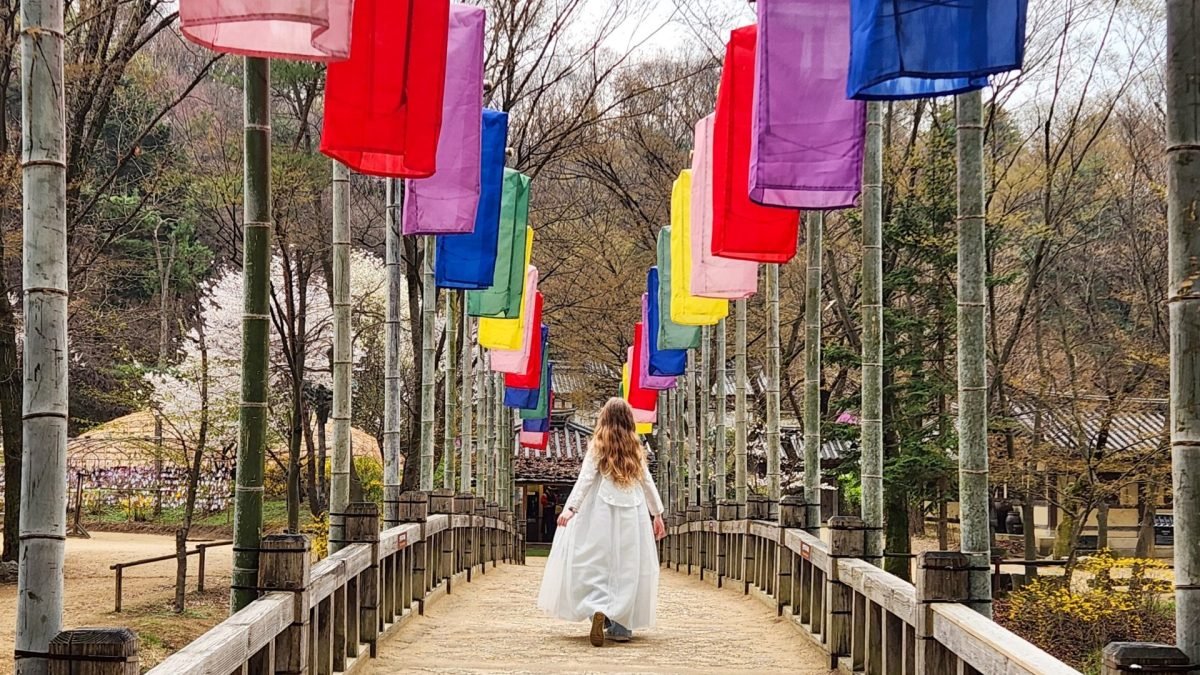
My daughter smoothed down her embroidered top and turned to look up at the cherry blossoms, their petals floating gently down towards the water. Dressed in a traditional Korean hanbok outfit, with tree-fringed steps and low curving wooden roofs in the background, it felt like a moment out of time.
I’d assumed modern culture would be the highlight of my 13-year-old’s trip to South Korea, but watching her face light up as we strolled through Yongin Folk Village, an hour or so outside Seoul, proved the country’s past was just as engaging.
We’ve visited more than 30 countries together, but for my daughter – a firmly committed K-pop fan with an encyclopaedic knowledge of her favourite groups and their dance routines – a holiday here has long topped her bucket list.

And she’s not alone. Tourism to South Korea is soaring, with visitor numbers up almost 50 per cent in 2024 and likely to rise further with the recent launch of Virgin Atlantic’s new flights from Heathrow. Younger travellers are helping to drive this boom, with figures from Trip.com showing last summer’s release of K-Pop Demon Hunters alone prompted a 34 per cent rise in flights booked from the UK to Seoul. Hallyu (the “Korean wave”) – a term describing the global popularity of South Korean culture, from music and TV to beauty products and food – is undoubtedly a key driver.
We packed in plenty of teen musts in Seoul, including shopping for K-pop merch in Gangnam and browsing ramen in 7-Eleven, but our trip weaved in just as much history and heritage. We were far from the only ones dressing in the unexpectedly comfortable hanbok, which secures free entry into Seoul’s palaces for anyone who wears it. Perfect for blending in at 600-year-old Gyeongbokgung Palace, where performers in vibrant silk uniforms re-enact the medieval changing of the guard ceremony here twice a day to a soundtrack of drums, conch shells and horns.

A 20-minute walk away, as locals relaxed in deckchairs at a pop-up library on the banks of Cheonggyecheon stream, my daughter lived out her K-pop dreams performing in the interactive rooms of HiKR Ground. Set inside the Korea Tourism Organization Seoul Center, it’s designed as an introduction to K-culture, with everything from virtual skateboarding to digital graffiti walls, plus a huge library of music and video backgrounds to record your own videos. In the UK, I’d expect eye-watering queues for this free experience but only a few other people were waiting.
There were other happy surprises for my bank balance, too: metro journeys cost less than 80p, entry to palaces is only £1.50 (if you aren’t dressed in hanbok) and you can eat until bursting in a restaurant for well under £10.
From Seoul, we took a day trip to the DMZ, the Demilitarised Zone between North and South Korea, 50km or so from the city. It’s an unexpected haven for wildlife, with landmines helping to keep humans out, but visitors are allowed in parts of the surrounding buffer zone. Looking through telescopes across the border, the single inhabited village we could see seemed eerily deserted, and it was flanked by equally silent ornamental propaganda villages.

We descended into the “third tunnel” – so called because it was the third known tunnel dug from north of the border into the south – which would have allowed an invading force of 30,000 soldiers to pass through each hour. A steep incline slopes 350m down, leading 73m below ground, where the walls still carry scars from explosives used to blast through the granite. My daughter peppered me with questions about communist ideology on the taxing climb back up.
We could have easily spent our whole 12-day holiday in and around Seoul, but high-speed rail connections make it easy to see other sides to the country; both the ancient capital Gyeongju and Korea’s second city Busan are just a couple of hours away.
In the former, about 150 symmetrical grassy mounds dot the landscape, housing the tombs of the kings of the Silla dynasty, which ruled Korea for almost a millennium from 57BCE until 935CE. Only a handful have been excavated so far, but 11,500 artefacts were found in one tomb alone, including the largest and most elaborate gold crown found in Korea, a gold cap, gold belt, gold diadem, gold earrings and even gilt shoes. Unsurprisingly, Gyeongju is nicknamed “the Golden City”.

The whole city keeps one foot in the past. We wandered past cafes selling cute pink strawberry mochi snacks, and around the corner we tucked into traditional Korean dishes on a street given over entirely to restaurants in traditional, low-rise buildings. Known as hanok, they often come complete with courtyards with trickling streams and ornamental bridges.
Some of these houses are available for overnight stays, too, although happily we discovered that history comes with mod cons. Bed still meant a futon mattress, but there was also underfloor heating, a mini fridge and en-suite bathroom.
Less than an hour from Gyeongju by fast train, Busan is modern Korea through and through. It’s the fifth busiest container port in the world and bridges stretch for miles, with one spiralling 360 degrees as it climbs high above the water. Beyond the glimmering skyscrapers, we found another taste of Korean tradition – painting our own calligraphy mottos in hangeul script under the watchful eye of calligraphy master Mrs Choi.

We then learnt to make gimbap with Park Kyung-hee at her home. This snack of rice wrapped in seaweed is often called Korean sushi, but the cooked fillings are designed to keep for longer than raw fish. The trick, we discovered, is not to overstuff your seaweed square. As we watched our host stir glass noodles in homemade soy sauce to create japchae, my daughter eagerly devoured a plate of crispy courgette slices and wondered why there were two big fridges in the apartment. One, revealed Mrs Park, is entirely for kimchi, packed into red tubs that won’t show the chilli stains.
Korea has over 200 recognised varieties of kimchi and traditionally families make it once a year, although Mrs Park is currently stocked up for a couple of years. If fermented cabbage is still something of an acquired taste for my teen, there’s no question this trip has only whetted her appetite for all things Korean.
How to get there
Virgin Atlantic, Korean Air and Asiana Airlines fly non-stop from Heathrow to Seoul.
Where to stay
Moxy Seoul Myeongdong has doubles from about £120 and Felix by STX hotel in Busan from £50. Hanok in Gyeongju can be booked from about £26 via popular online booking sites.
How to do it
Intrepid Travel has an eight-day South Korea Family Holiday tour from £3,537 for one adult and one child, excluding flights. [can cut this bit for space if need be – writer wasn’t hosted]
More information
visitkorea.or.kr