
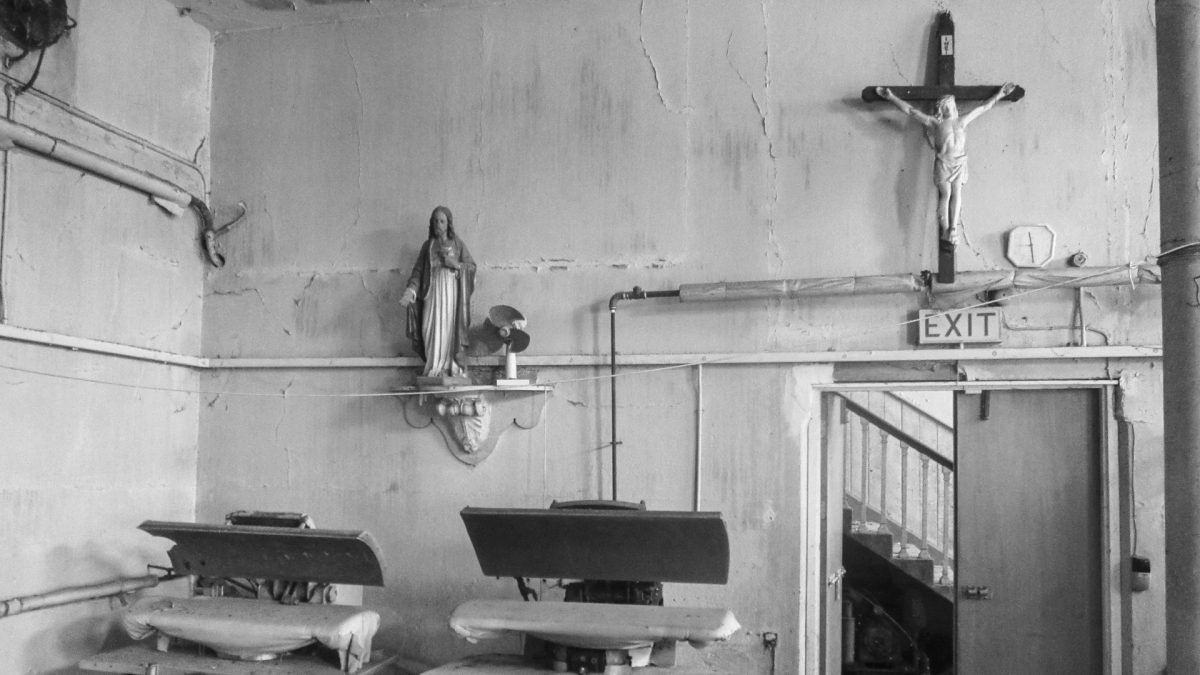
Brigid was 12 years old when she was sent to a Magdalene Laundry. Her hair was cut off, she was renamed “Peter”, and she was so lonely she’d go to the toilet at night just to listen to a dog barking out of the window… until one of the nuns cottoned on and nailed it shut.
It was 1948, and Brigid would still be at the Good Shepherd Laundry when it – and all the remaining others – closed at last in 1996. By then it was the only life she’d known. So she moved next door, to an apartment run by the same nuns, and kept her radio on all hours of the day, tuned to a station that played endless Mass on loop.
Her sin, the one that condemned her to a lifetime of detention and institutionalised her so deeply that even when she was free she did not feel fit to do anything else? Truancy. Her local priest thought that skipping school was a sign of “a deeper, inherited moral malaise”.
Many of us are aware, with great horror, of the Magdalene Laundries: secretive Catholic institutions that imprisoned tens of thousands of “fallen” women, most aggressively after Irish independence in 1922.
They were a part of ordinary Irish life: not hidden, as familiar in a town as the butcher, post office, the pub. But the women inside were not part of Irish life at all. They were not to be looked at, not to be spoken to, certainly not to be spoken of, by the families they left behind.
Girls as young as nine and women as old as 89 were locked up, forgotten, and forced into violent, relentless slave labour washing clothes, enduring Ireland’s stench and dirt. It took more than 70 years for them to close, even longer for the survivors to receive a formal apology in 2013, and it will take even longer for the shame of it to disappear.
The Fallen, a new book by the Irish academic Louise Brangan, is a devastating read. It is a testament to survivors and victims of the Magdalene Laundries that takes us so closely into the memories and traumas of these abandoned women that you feel you can smell the urine on the sheets. It points out that the laundries and their purpose have been fundamentally, dangerously, misunderstood. In collective memory, we have mixed them together with the equally abhorrent Mother and Baby homes as part of some grim, punitive past that robbed women of their human rights.
If the Magdalene Laundries were penitentiaries for wayward women, it would be bad enough. In fact, they were a means of systematic mass incarceration, driven not by desire to reform and rehabilitate, but to forcefully remove from society.
No babies were born in a Magdalene Laundry, and most of their victims did not have to do anything as extreme as get pregnant to end up in one. As a totalitarian Catholicism took over the nascent independent nation of Ireland, the pursuit of utopian, devotional perfection became a national obsession. Anyone that strayed from that picture was a stain to be erased. The nation grew insular and intolerant, closed to foreign ideas or cultures, and obedient silence became good, respectable manners.

In this climate of “heresyphobia”, a “fallen woman” did not need to have committed any outright sin. That description encompassed something much wider and could be twisted and manipulated as anyone seeking to control her saw fit. As one priest said, the fallen woman was “lustful, indulgent, had foreign tastes, was unbridled by the demands of family; she lacked moral fibre”. Even “women on the verge of being wrecked in the whirlpool of the busy world” were a risk. The more descriptions of fallen women I read, the fewer women I could think of who wouldn’t qualify.
Brangan’s book forensically charts the history of the laundries through the stories of several women and the bleak reasons they got there. Some were sent by a local priest, some went after leaving an “industrial school” or Mother and Baby home, some were inconvenient members of their families, some misbehaved at school, some were too spirited, some were born to an illegitimate mother. Some were picked up by Catholic fanatics “roving the city’s streets in search of women and girls in imminent moral danger”. No matter their age, their story, where in Ireland they were sent or how long they stayed, each of them spoke of the same worthlessness, the same brutality, the same shame.
When a girl arrived at a Magdalene Laundry, she usually did not at first realise she was in one. Her clothes, hair and name would be removed, she would be taken to a group dormitory, and rather than introduced to young girls like her, she would be faced with silent, older women who barely looked up. One girl, on encountering aged and infirm women rocking back and forth, wondered: “Am I going to be looking after these old people?”
But soon she would understand that she was destined to become one herself. This was, Brangan writes, “something between a conversion camp and a gulag”, with a deliberate environment of “ever-present, ambient fear”. Women slept in mass dormitories with barred windows, were fed porridge, toast and gristly stew, and a weekly dose of Epsom salts as laxatives to help pass the stodge.
There were no clocks – the days passed, divided by work and prayer. One woman spoke of using scrunched-up newspaper for loo roll. They washed every other Sunday, the bathwater changed only after 10 women had used it. Meanwhile, the work in the laundry was vicious, scrubbing “soiled underwear, sticky hankies, or the butcher’s aprons with hard, clotted stains” using burning, industrial bleach and terrifying machinery that when broken, would not be fixed – instead the nuns would say a prayer. Some girls lost hands and arms.
Punishment for any infraction was just as inhumane: one woman remembers a girl forced to eat her dinner from a bowl on the floor, like a dog. The enduring psychological torture was even worse. “Each of the women was made to feel a deep indignity for having existed, for having brought ignominy on the world around her with her illegitimate presence,” Brangan writes. Nuns would remind them that they were fat, filthy, unwanted, worthless, that nobody was coming for them. Usually, nobody did. During this period, Brangan points out, men would often serve fewer than seven years in prison for murder, and Ireland was considered to have one of the most humane prison systems in the English-speaking world.

Of all the horrors, what stands out is the loneliness. No talking, no playing. Friendships were forbidden, girls were not permitted to speak of their past lives, names or families. Meals were eaten in silence, at tables facing in the same direction so no girls could so much as catch each other’s eye.
In a society with such an oppressive culture of obedience, most girls had not been raised with the language to critique or question. So they submitted. Became zombies. Watched those around them grow old and die there, knowing it might one day be them, “compounding their terror”. They were, Brangan writes, “bleaching and compressing their personalities as well as the sheets”. On the outside, nobody asked after them. “Ordinary people learned not to ask about those girls, never to mention their names, let alone grieve their absence.”
When women did die in the laundries, it would be with no ceremony. Brangan reports burials in unmarked, mass graves, with inconsistent records of just how many bodies were in there. Some women would try to escape, only to be rounded up and returned, and forced to wear their underwear and a sheet as a cape, their hair cut even shorter.
Life for those who were freed, or left as the Church loosened its grip on Ireland, was not a liberation. Survivors were left struggling for work with limited life skills. “All I needed was someone just to push me because my life would have turned in a different direction,” says one survivor, Betty. Some found it so hard in the real world that they returned to the nuns. Some believed the nuns had become family. Many of those who didn’t faced a lifetime of poor health and poverty.
Meanwhile, the psychological trauma continued to punish them. Brangan writes of women left believing what they’d been told – “you are nobody” – and with a permanent fear that something, at any moment, could go wrong. They felt unable to love or be loved, unable to shake the stigma, unable to speak of their abuse even to their husbands and children, and encouraged to leave matters well alone by a culture that deemed talk of such things unseemly and impolite.
Ireland, the “nation of a thousand welcomes, of storytellers, a classless society of good craic and good times”, still turned away from these women, who had their life chances stolen despite never having done anything wrong.
The Fallen is one of the most gruesome books I have read in a very long time. On every page is the visceral dread of “that door locking behind you and you were never, never, never to walk out that door again”. It is an account of a near century of unfathomable cruelty, the threat of populist ideology, and the danger of silence and compliance, all made more astounding for its recency. No apology for these women will be enough.
I hope, at least, that they are at last in no doubt that the shame of the Magdalene Laundries was never theirs.
The Fallen is published by Bodley Head, £22