
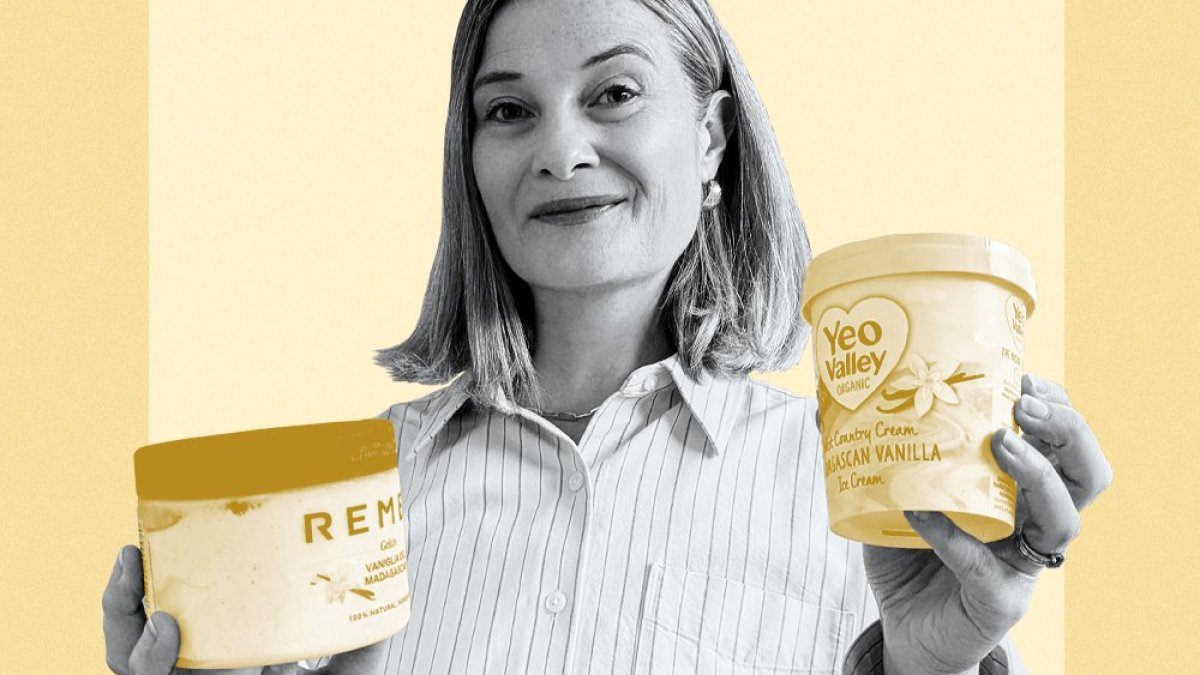

Never work with children or animals, they say, but ice cream is a similarly risky business given its penchant for melting the minute that the weather heats up. I’ve worked in ice cream parlours and on dessert stations where scoopers desperately work out logistics for serving hundreds of tiny iced treats, and paw molten custard into cones while queues snake around the block.
Thankfully, getting a tub to enjoy at home is a far less fraught experience, whatever the temperature. I do think the quality has improved as we’ve become more discerning about food overall.
A decade ago, ice cream parlours were for seaside towns and big cities, whereas now we can find decent shops with plentiful flavours all over the country. In supermarkets, the premium own brand ranges are all decent and mostly made of what ice cream should be – a custard base made with milk, cream, egg yolk and sugar, plus flavourings.
I only try one gelato for this taste test, Remeo. To be honest, I find that arguing the relative merits of gelato vs ice cream is a bit like the cream or jam first debate when it comes to scones: tiresome and unnecessary when both are delicious.
Ice cream has a custard base (made with egg yolks) and gelato, its Italian cousin, typically uses less cream and yolk and often no egg at all. It is therefore lower in fat than ice cream with a traditional custard base and higher in sugar. It is churned at a slower speed, which means the result has less air whipped into it and comes out smooth and dense – that’s why it can be pasted high onto cones whereas ice cream works better if scooped.
Much has been said in recent years about ultra-processed ice cream, after Dr Chris Van Tulleken highlighted the emulsifiers, stabilisers and preservatives that often appear in cheaper (and not so cheap) supermarket ice creams in his book Ultra-Processed People. These ice creams have been created to present as scoopable straight out of the freezer while not melting too quickly, and tend to have a somewhat spongy texture. The effect is that they expand in the mouth, not unlike foam.
One of the biggest stress factors for ice cream producers is the price of vanilla, an expensive ingredient that fluctuates wildly. The better ice creams that I try use a combination of extract and powder. Those using a flavouring tend to taste sweeter. Although I haven’t tested any dairy-free products for this piece, my favourite is Booja Booja.
There’s so much good ice cream around that my head is easily turned, but my favourite vanilla at the moment is Brickell’s Vanilla Bean, made with Westcombe Dairy milk in Somerset. It’s usually around £7.50 a tub and while it’s not available at any major retailers, I found it in a local convenience store – definitely worth looking out for.
I tried 12 vanilla ice creams to see where you should spend and where’s better to save.
Sainsbury’s Taste the Difference Vanilla Ice Cream, £3.50/480ml
This ice cream has a rich and creamy taste and a decent hit of earthy vanilla without any overly sweet notes. I was looking forward to it as I’m a fan of Sainsbury’s Taste the Difference Belgian Chocolate, and I’m not surprised to learn the vanilla is made with the same West Country double cream, along with milk, sugar and egg yolk.
As with most of the premium lines, the vanilla comes from Madagascan extract and powder, and this tub has decent black spots of vanilla throughout. The plastic seal reminds hungry consumers to wait 10 minutes after taking out of the freezer for a better flavour, and it is infinitely better to occupy yourself for a few moments rather than jab at a frozen block!
3.5/5
M&S Collection West Country Madagascan Vanilla Luxury Ice Cream, £4.50/500ml
A deliciously creamy and rich vanilla with a gently melting mouthfeel and warming notes of Madagascan vanilla. It contains slightly more cream compared with the other better quality tubs, as well as dark brown sugar, and I think this gives it the edge.
4/5
Tesco Finest Madagascan Vanilla Ice Cream, £3.50/480ml
This one looks good and has lovely speckles running through each scoop. It’s not quite as rich or smooth as the Sainsbury’s Taste the Difference, though the dairy claims to also be from the West Country, but the gentle but definite vanilla flavour is there. The mouthfeel is a bit fluffy, which I suspect is caused by the maltodextrin, a thickening agent, but overall it’s not bad.
3/5
Yeo Valley Organic Vanilla Ice Cream, £4.75/500ml
A really delicious organic ice cream and proof it can be done without an overly long list of ingredients. There’s a rich custard base, pretty dots of vanilla and the comforting flavour of real vanilla from extract and powder. I’ll try the Yeo Valley mint choc chip ice cream next, as I’m not a fan of most retail versions, but this feels promising.
4/5
Ms Molly’s Vanilla Ice Cream, £1.35/2l
I know this price point will appeal to many shoppers, but Ms Molly’s ice cream isn’t something I can recommend for its taste. When I lift the lid, streams of a gummy substance hang between the sides and the tub, like slime. The product itself is fluffy and sticky with no discernible vanilla flavour. It’s made from reconstituted skimmed milk concentrate, reconstituted whey powder, glucose, palm oil and a load of stabilisers, additives and preservatives. I’m fed up of the big food manufacturers fobbing consumers off with sub-par products, but I do think that if kids want an ice cream their lives will improve immeasurably from having one, whatever the quality.
1/5
Jude’s Vanilla Clotted Cream Ice Cream, Ocado, £5/460ml
I like the deep flavour of the clotted cream base but the vanilla flavour is a bit too sweet for me and I could tell it contained emulsifiers immediately because the texture fluffs up and sort of crowds out the mouth rather than melting smoothly.
2/5
Haagen-Dazs Vanilla Ice Cream, £5.75/460ml
Most of the premium ice creams are decorated with tiny specks of vanilla to prove they contain the genuine article, but Haagen-Dazs obviously doesn’t feel the need to compete on this level: it’s a pure creamy-white colour and easy to scoop straight from the freezer. It has a higher cream content (39 per cent) than any of the others I try (the next are M&S and Waitrose No. 1 at 34 per cent then Duchy Organic at 28 per cent) and a strong and sweet vanilla flavour from its vanilla flavouring, as well as added sweetness from condensed milk. I suspect it’s the condensed milk that helps with scoopability, too.
3/5
Waitrose Duchy Organic Vanilla Ice Cream, £3.75/480ml
Pale in colour and speckle-free, I might have mistaken this for a plain milk ice cream on a first taste. The vanilla is there, but it’s very subtle, so choose this if that’s your preference. There’s some good flavour from the organic dairy, a smooth texture and no additives or preservatives.
3.5/5
Remeo Gelato Madagascan Vanilla Bourbon Gelato, £6/462ml from Ocado
I enjoy the intense vanilla flavour of this Remeo gelato but I don’t find the texture remarkably smoother than the supermarket premium lines I try. In fact it tastes quite fluffy and doesn’t merit the higher price. The packet boasts “only natural” ingredients but there is still a vanilla flavouring, a natural stabiliser (carob seed flour) and extracted vanilla.
3/5
Carte D’Or Madagascan Vanilla Ice Cream Tub, £3.90/900ml from Ocado
Overwhelmingly sweet compared with most other ice creams that I try, and most similar to the Lidl Bon Gelati, which has a very similar ingredient list and I suspect has been developed as a Carte D’Or dupe. I’m not sure how, where or when Carte D’Or developed its reputation as a decent ice cream, probably down to the marketing geniuses at owner Unilever, but it’s not worth paying for or eating.
2/5
Lidl Bon Gelati Bourbon vanilla, £2.45/l
This Lidl premium ice cream has a very strong and custardy vanilla flavour, from “natural bourbon vanilla flavouring” and ground vanilla pods. The texture is fluffy and foamy, like it’s been pumped up with something, and reminds me of school ice cream. When tried alongside the Carte D’Or, however, it is a good copy and far cheaper, so if you like Carte D’Or, buy this instead.
3/5