
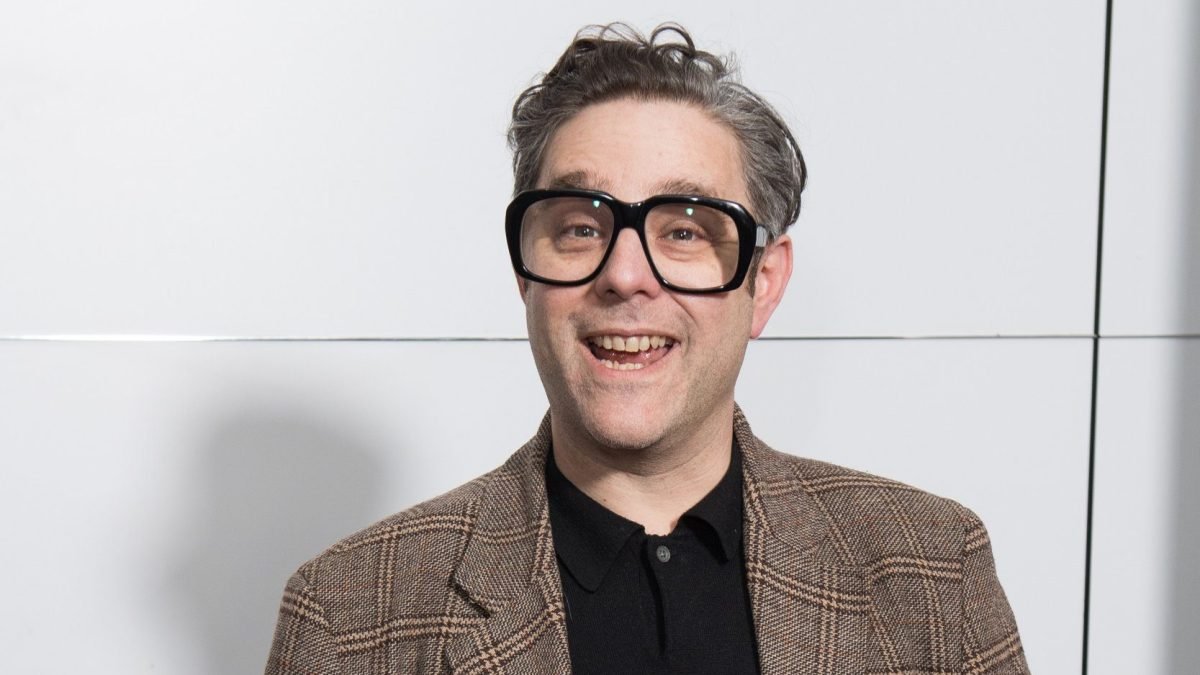
Andy Nyman has started an impromptu Ouija session on the cafe table between us. “A ouija board works on a thing called ideomotor syndrome,” he explains while skimming his hands like metal detectors scanning for buried treasure. “You and I would put our hands on the glass – or the planchet, as it’s called – and that would move around, spelling out a word or whatever… We’re both pushing it, but you’re unaware of the fact that you’re pushing it. And you feel that the other person is doing all the work. But more importantly, this thing ends up going on a journey that neither of you could have planned.”
I could say the same about that answer to my question about his creative process. But then, this is a man who’s made a 40-year career out of, among other things, mystifying audiences with supernatural thrills and mind-bending mentalism. One of the peak examples is Ghost Stories, the fright-filled theatre show he created with best friend Jeremy Dyson in 2010, which explored the fear of being a bad parent. The show has had numerous UK and international productions, as well as a film adaptation in 2017.
Despite loving magic and horror since he was a teenager, Nyman turned down a multi-year deal from Channel 4 to perform mentalism. The job was eventually taken by Derren Brown, with whom Nyman has worked on all but two of his shows – he co-created and co-wrote Derren Brown – Mind Control and Trick of the Mind, among others – and who he says gave him the confidence to write Ghost Stories. “We sort of pioneered a new way of doing mind-reading stuff,” the 60-year-old says of their alchemy. “My skill base really was taking very old-fashioned effects, and revolutionising them, giving them a sort of modern version. Derren had this brilliant, cutting-edge way of thinking. And it was like this marriage of these two tastes.”

Nyman’s “first love”, though, is acting, having starred in glossy West End musicals, including Fiddler on the Roof and, more recently, The Producers. His eyes twinkle when I ask if he considers himself – to borrow the title of one of Brown’s shows – a showman. “If someone asks me what I do, I say I’m in showbusiness,” he says, letting out an appropriately flamboyant guffaw. “Showbusiness is such an old-fashioned, glamorous, drive a Rolls-Royce, smoke a cigar, big coat sort of answer that I love.”
But he’s not disheartened that a solo vehicle for his talents is yet to come back his way. “Life’s too short,” he says. “There are too many painful bumps in the road. If I can craft a life whereby I’m doing what I love and it makes me happy, that’s all I care about. I’m not interested in fame, I’m not interested in being rich for the sake of selling my soul… But could I do a one-man show? Oh, yeah – and probably will at some point.”

For now, he’s reuniting with Dyson on their latest collaboration, The Psychic, opening this week at York Theatre Royal, where we meet after rehearsals. The thriller follows a TV psychic as she tries to restore her reputation after being dragged through the courts and the papers as a fraud, losing a fortune in the process. Coming in the slipstream of shows like Paranormal Activity and 2:22 A GhostStory, the play arrives at a time when supernatural horror is enjoying a sunny spell in theatre. He believes the genre fell out of fashion due to a snobbery around horror, tending not to elicit a “cerebral” response. But “when you see a good one, Oh my god, there’s nothing like it. And that’s what our intention with The Psychic is… I’d love to think that we could rebirth that genre.”
He’s infectiously nerdish about the “delicious” analogue and the practical effects they hope will achieve that. “If we get it right, the reactions are going to be unbelievable,” he says. “It is mischievous, it is puckish, and it is naughty, but it also really delivers incredible plot twists, surprises, shocks, and big laughs. It’s all the things that make Jeremy and myself thrive.”

With theatre tickets costing “a sh**load of money” today, the duo feel a greater pressure to deliver. But what bothers Nyman most is the perception these prices create. “It’s such a misnomer to think the arts are just for the elite,” he says. “What the arts generate financially in this country is gigantic… It needs to be nurtured so that everybody has access to it. And I know that sounds like another boring actor banging the lefty drum about theatre, but it isn’t about that. You’ve got it at the same time as you’ve got what looks like rises in street crime and disenfranchised people. People need to feel fulfilled… It’s an absolute saviour for people – I really profoundly believe that.”
Nyman talks with the gentleness of a father reading a bedtime story and seems innately optimistic, so what draws someone like that to the darkness of horror? “[People] often think it’s really subversive and demented and can’t understand why you’d swim in those waters,” he says. “I think ultimately there is something very life-affirming about horror.” That’s why he thinks supernatural thrillers endure, quoting a line from the play: “‘Look, we are all the same: we’re sh**-scared of dying, sh**-scared of being broke, sh**-scared of being ill.’ And it’s the truth. And the need for answers is massive… So of course we’re fu**ing obsessed with trying to make sense of the biggest thing in the world, which is: we’re gonna die, and the people we love are gonna die – and how do you deal with that? How on earth do you square that circle?”
They’re particularly resonant questions for Nyman, following the death of his wife of 35 years last June after a 16-year illness. “Grief and suffering are not something that’s adjacent to my life; that’s a part of my life,” he says. “There are themes and ideas in [the play] that are touching on that world, and are interesting and potentially helpful and healing – and maybe painful as well.”

It’s still visibly raw for him, so I ask whether making the show has helped. “If you put it out there fearlessly, just put it out there, that is the only way you can truly touch people and heal potentially with your work,” he says. “And that isn’t something to be embarrassed or guilty about or shameful about. I think it’s an essential part of trying to create work that is truthful and honest and impactful.”
I wonder whether, looking at other figures in the public eye today, truthfulness is becoming as old-fashioned as his magic tricks. “What’s changed is, back in the day, if someone’s revealed to have done something sh**ty, there seemed to be repercussions,” he says. “We seem to live in a world where that doesn’t seem to happen anymore… It fascinates and terrifies me that we live in a world where the notion of truth is just in flux. It’s extraordinary to me to watch that happen. So I love holding it up and shining a really bright light on it… The strapline of the play is: Is any of it real? And it’s sort of the question at the heart of everything.”
‘The Psychic’ is at the York Theatre Royal until 23 May (yorktheatreroyal.co.uk)