
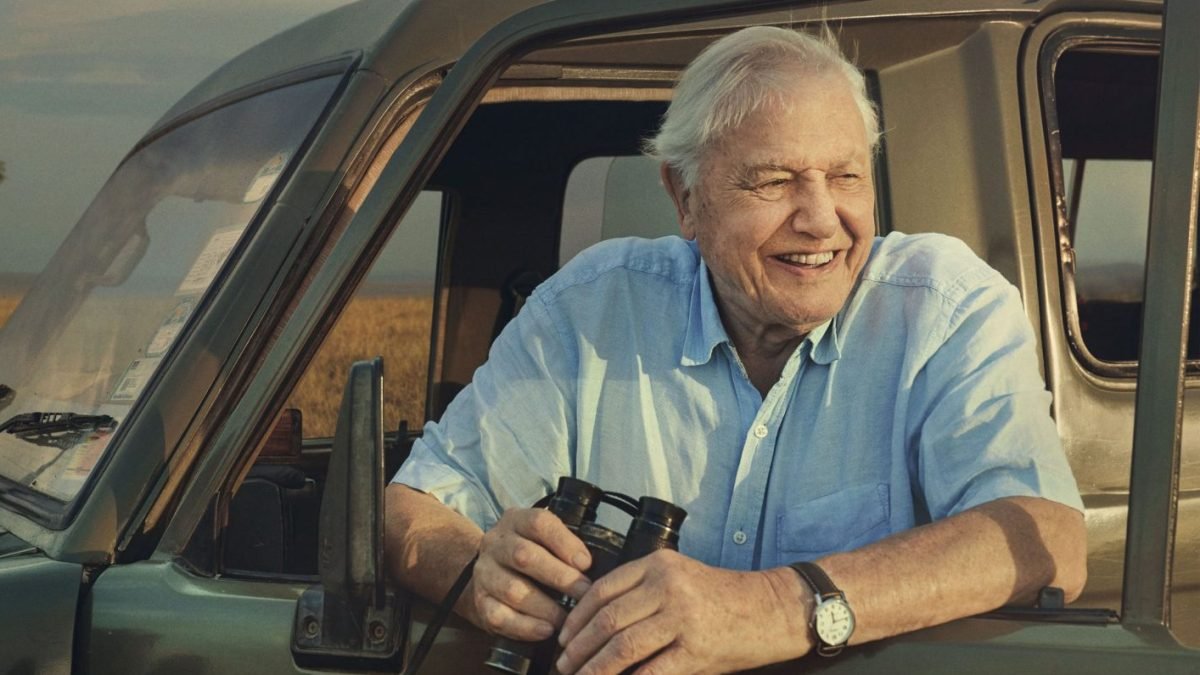

Award-winning biologist, bestselling author, iconic broadcaster, owner of one of the world’s most recognisable voices, and – as of today – a centenarian. The vast majority of us have never known life without Sir David Frederick Attenborough’s trademark awestruck narration emanating out of our televisions.
For decades, he’s been introducing us to wildlife wonders and passionately advocating for environmental preservation. In the process, his wise face and reassuring whisper have made him the nation’s surrogate grandfather. Few people in history have had such a powerful impact on how we view our planet.
Even at the grand old age of 100, the tireless hero continues to inspire, enlighten and entertain us. A prolific recent burst of activity has seen him broadcast three new projects already this year. And tonight (8.30pm, BBC One), Kirsty Wark will host a star-studded event live from the Royal Albert Hall celebrating Attenborough’s career, soundtracked by the BBC Concert Orchestra.
In birthday tribute to the great man, I’ve selected the most memorable moments from his mighty body of work – from greeting cannibals to being tickled by baby gorillas, from bonding with rhinos to walking with royals. This is Sir David Attenborough’s world. All we can do is sit back, marvel at it and try to preserve it for future generations. Happy 100th, Sir Dave, and thank you for everything.
Groomed by a gorilla
Life on Earth, 1979
The most famed Attenborough moment of all. In Rwanda, he came face-to-face with a female mountain gorilla. The next day, she remembered him and ventured over to groom and play with him. He was suppressing giggles because two baby gorillas were removing his shoes at the time.
It seems unbelievable now but the magical moment almost never saw the light of day. Not only was the cameraman worried about using up all his film but Attenborough’s producer was annoyed he’d gone off-script and threatened to drop it from the final cut. Happily he saw sense. Besides, the presenter’s ad-libbed line was unforgettable: “There is more meaning and mutual understanding in exchanging a glance with a gorilla than any other animal I know.”
Face-to-face with a fox cub
Wild London, 2026
Attenborough focused his attention closer to home this year, with BBC series Wild London and Secret Garden. This magical moment saw him get up close to a family of playful urban foxes on a Tottenham allotment. “Even though there are more wild foxes in London than in almost any other big city,” he said, “it’s still a huge thrill to see one suddenly emerging from the bushes. A totally wild creature.” As a pointy-eared, wide-eyed cub came within feet of his folding chair, Attenborough’s face lit up and he greeted it with a gentle “Hello”.
Greeting a cannibal tribe
Zoo Quest, 1957
It doesn’t get much more British – or more fearless. In this early wildlife film, a baby-faced Attenborough ventured into the jungle of Papua New Guinea, where he chanced across a tribe of reclusive cannibals. On Michael Parkinson’s chat show, he recalled a hair-raising moment when he saw the glint of a knife and the tribesmen rushing towards him. “To say I was alarmed is putting it mildly,” he chuckled. “But I walked towards this screaming horde of men, stuck out my hand and heard myself say ‘Good afternoon!’” Thankfully, the tribe greeted the relieved presenter warmly.
Iguanas vs racer snakes
Planet Earth II, 2017
A classic predator vs prey clip, as thrilling as any Hollywood chase. A freshly hatched marine iguana emerged from the sand and was immediately forced to run for its little life as a sinister army of Galapagos racer snakes ambushed it on the rocks. Viewers were firmly on the iguanas’ side – even though, as Attenborough pointed out, “This is the best feeding opportunity the snakes will get all year”.
The Bafta-winning sequence later caused controversy after it emerged that it had been edited together from several takes of different iguanas, but that’s standard practice. Attenborough let the images speak for themselves, using narration sparingly as the slithery, scaly pursuit unfolded.
Saying ‘boo’ to a sloth
The Life of Mammals, 2002
Up a tree in the Costa Rican rainforest, Attenborough uttered a playful “boo” at an unsuspecting sloth, who was far too laid-back to be startled. After drawing in viewers with that comedy moment, he delivered a fascinating account of the sloth’s behaviour, calling it “a mobile compost heap”, comparing his own day to the sloth’s and explaining how the painfully slow mammal risks its safety to defecate in the same spot on the forest floor once a week. The drawn-out way he pronounced “slow-th” was the icing on a joyous cake.
Strolling with the Queen
The Queen’s Green Planet, 2018
Two much-loved nonagenarians, born just two weeks apart in 1926, taking a walk together and nattering about nature. What could be lovelier? This one-off BBC documentary about the Queen’s Commonwealth Canopy – Elizabeth’s ambitious legacy project to create a global network of protected forests in all 53 Commonwealth countries – saw the late monarch and Attenborough strolling around Buckingham Palace gardens, chatting about her love of trees. She chuckled good-naturedly about noisy crows, even noisier Americans and James I’s horticultural mishaps.
Feathered impressionist
The Life of Birds, 1998
Proof that even when you’ve travelled the globe and seen it all, you can still be wowed. Attenborough was truly astonished when this Australian lyrebird – which woos its mate by copying the calls of other birds – uncannily impersonated other everyday sounds it hears, including a camera shutter and a car alarm. Yet the merriment took a more serious turn when the forest-dwelling bird proceeded to mimic the sound of a chainsaw cutting down its threatened habitat. In 2008, this memorable moment won a viewer poll to choose the best Attenborough clip of all time.
Blue whale up close
The Life of Mammals, 2002
A memorable moment that’s often mistakenly assumed to feature in The Blue Planet but which actually aired a year later in Attenborough’s next epic series. The naturalist can hardly contain his delight as he rides on a tiny boat and the mightiest of all marine mammals surfaces right next to him, dwarfing his vessel. Awestruck, he explains how no animal of this size could survive on land because no bone is strong enough to support such huge bulk out of the water. Right on cue, the whale dives back down, its vast tail eventually disappearing beneath the waves into the dark depths below.
Watch on BBC iPlayer
Rugby-tackled by a capercaillie
The Life of Birds, 1998
The world’s largest variety of grouse – weighing in at up to 5kg – proved more than a match for Attenborough when its gander was up. When the presenter entered the capercaillie’s territory in the Highland pine forests, an amorous male mistook him for a romantic rival. Easy mistake to make. Defending its turf, the normally shy bird chased his around before charging straight into his knees, sending the amused Attenborough flying into the heather. One of the funniest moments of his broadcasting career.
Covered in red crabs
The Trials of Life, 1990
One essential skill of a wildlife presenter is not to be freaked out when animals crawl over you. Even when there’s millions of them. And they’ve got pincers.
On the moonlit beaches of Christmas Island, 100 million female red crabs were ready to spawn and crowded together so closely, the coral cliffs looked crimson. By torchlight, Attenborough gently tiptoed between them and casually sat on a rock as they swarmed past. Ever the consummate pro, he continued calmly addressing the camera as one crustacean scuttled up his leg.
Laying with a leatherback turtle
Blue Planet II, 2017
His trademark whispery voice is known across the world but Attenborough’s physical appearances can be pretty iconic too. On a Trinidadian beach, a local hero called Len educated the public about the importance of conserving the endangered turtles. Attenborough sprawled on the beach next to a huge adult turtle, both looking equally wise, before tenderly placing a baby on the sand to start its perilous journey into the ocean. “Good luck, little leatherback,” he said.
Base-jumping baby geese
Life Story, 2014
Wait for me, mum! Attenborough’s documentaries make us gasp in wonder and giggle with laughter. However, they also possess the ability to break our hearts.
A downright devastating sequence found fluffy barnacle goslings in Greenland hurling themselves off 400ft-high rock ledges in a bid to reach their mother on their ground. Just two days old and still unable to fly, the newborns must jump or starve. As slo-mo footage captured every agonising bump off the jagged cliff face, the birds’ parents – and Attenborough – tried to work out which had miraculously made it. As Attenborough philosophically notes: “Luck will play its part.”
Catching a python
Zoo Quest, 1956
In a throwback to the pre-health and safety era of natural history programming, a 30-year-old Attenborough tried to catch a 3.5-metre Burmese python. Spotting one up a tree, he climbed up, hacked down a branch, inexpertly threw a sack over its head, grabbed it and handed it to a local man, who thankfully appeared rather more skilled at this snake-catching business.
“It looked enormous,” he told viewers. “From its size and markings, I was quite sure it was a python and therefore non-poisonous, which was something of a relief.”
Summoning a woodpecker
The Life of Birds, 1998
A brilliant demonstration of territorial sounds in the animal kingdom. Cannily taking advantage of a male bird’s innate curiosity when he thinks a rival has encroached on his patch, Attenborough banged loudly on a resonant tree trunk on Patagonia’s Tierra del Fuego, mimicking the Magellanic woodpecker’s signature double knock. Sure enough, a large male responded immediately, popping its red head around the tree for a closer look, then perching right above the presenter’s head and banging the tree even harder.
A king among penguins
Life in the Freezer, 1993
“I am at the very centre of the great white continent.” For the opening episode of this Antarctica series, Attenborough was filmed nonchalantly sitting among a colony of 600,000 king penguin, complete with their crèche of 50,000 nesting chicks. Since they have no land predators, the waddling birds were supremely unbothered by his presence. In fact, he explained, they were intensely curious so gathered around for a closer look. Putting himself at the heart of the action lends extra immediacy to his typically effective narration.
Bonding with a blind baby rhino
Africa, 2013
“Hello little friend.” Attenborough’s series about the wildlife of Africa climaxed with an enchanting close encounter. When a blind baby rhinoceros called Nicki wandered into shot at the end of a day’s filming in Kenya, Attenborough got down on all fours, stroked Nicki’s snout and returned his inquisitive squeaks with similar noises of his own. He described how a cataract operation might save Nicki’s sight and give him a chance of survival in the wild. “There is hope for this little fellow,” he concluded. Touching and utterly adorable. No, you’re crying!
‘David Attenborough’s 100 Years on Planet Earth’ is on tonight at 8.30pm on BBC One