
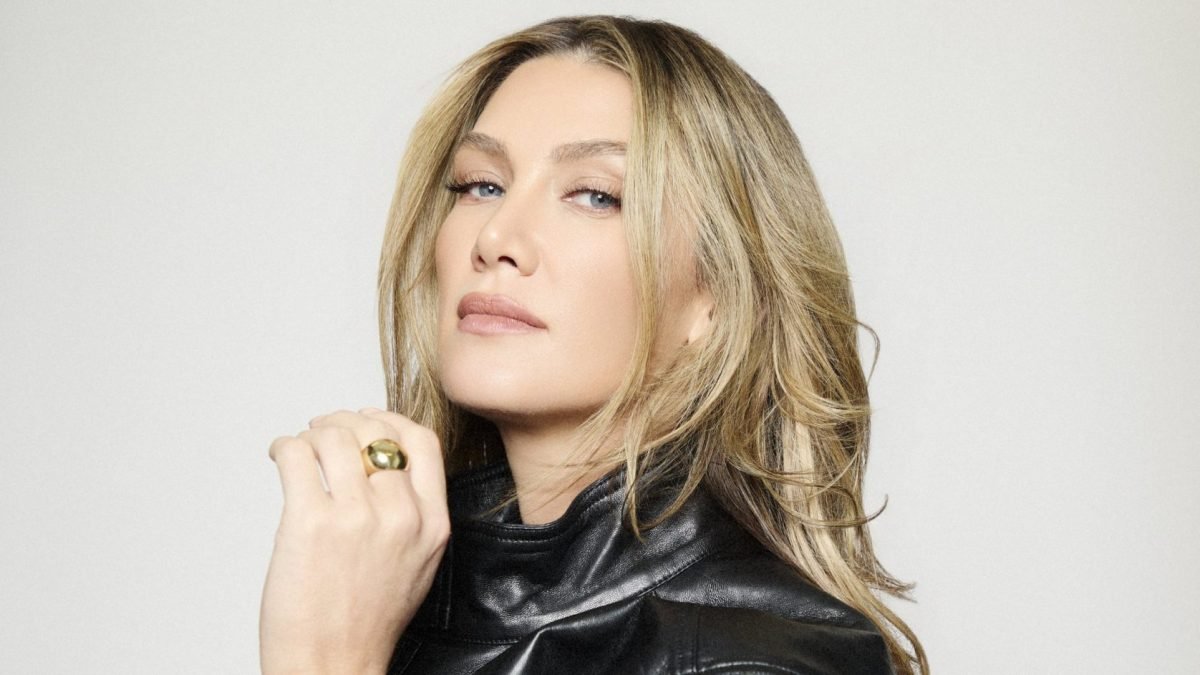
The fact that Australia – a nation 10,000 miles away from its European not-so neighbours – is an honorary entrant into the Eurovision Song Contest is one of many bizarre, brilliant and frankly bonkers things about the whole extravaganza.
The Aussie audience were rewarded for their collective enthusiasm and time zone-restricted viewing dedication when, in 2015, their country was invited to take part in the annual theatrics – and, this year, they have persuaded a national treasure to represent them. So long as she makes it through the semi-final, Delta Goodrem will be taking to the stage in Vienna to perform her suitably Eurovision-esque power ballad “Eclipse” in the grand final next weekend.
As fun and OTT an experience as it all is, the possibility of nul (or few) points is mortifying for any act, let alone an established performer (just ask Olly Alexander or Bonnie Tyler). But, for Goodrem, it was a pretty easy “yes” when the Eurovision universe came calling.
“I’m a measured person – I take everything in and allow it to simmer,” she says. “In the past couple of years, Eurovision has been more and more around me. I was always on a project or a tour or something but, last year, I was here doing shows when Eurovision was on, so I got to feel the energy in the air. It’s early in the morning when it’s on in Australia, so to be here experiencing it, I thought it was so incredible.
“I’m always open-hearted and I know to do something when I’m excited by it. This is a celebration. I’m bringing Australia with me in my heart, and I love seeing everyone there excited to get even more involved this year.”
But the fear of nul points? “I can’t control what happens. What I can control is my mindset and making sure that it’s the best it can be. That’s my job, and the rest of it… I feel grateful to be a part of this Eurovision community so whatever is meant to be. But I will give it everything I’ve got.”
Should she pull it off and win, there would be the considerable logistical issue of what Australia hosting the show would look like. “It’d be so fun. I mean, I think we’d be a great host, we’d definitely want to look after everyone. Whether that’s possible or not, I have no idea – but imagine the pre-party barbecues.”

Now 41, Goodrem has had a long and fruitful career, starting out as a child star at the age of 15 with a recording deal from Sony. At 16, she landed a part in Neighbours as aspiring singer Nina Tucker, a role that went nicely in tandem with her music career.
She has since sold more than eight million albums globally, and one in four Australian homes has a Delta Goodrem album on its shelves. For eight years, she was also a judge/coach on The Voice Australia, where she sat on a revolving chair next to artists including Good Charlotte’s Joel Madden, Seal, Keith Urban and Ricky Martin.
She also formed a close friendship on the show with Boy George – who just happens to be her “healthy competition” on Eurovision this year. “I was like, ‘What do you mean George is going?’ Oh, he just can’t stay away!”
Indeed, another fabulously random Eurovision moment this year comes from Boy George accompanying the singer Senhit in representing San Marino, the tiny independent republic encased by Italy (which, unless we’re very much mistaken, isn’t where he was born and bred – but who cares, this is Eurovision after all).
“I feel like it’s extremely George. When you think about Eurovision, you think about individuality, creativity, joy, the theatrics, the trailblazers. It makes a lot of sense for George, who’s a trailblazer himself and has been a cultural phenomenon throughout his career,” says Goodrem. “I love that George and I are doing the same year. We’ve always had a playful dynamic. We’ve been really supportive of each other from day one.”
Goodrem has had a lot to be supported through in life, much of it health-related. At 18 and at the peak of her early fame in 2003, she was diagnosed with Hodgkin lymphoma, a cancer of the lymphatic system. At the same time, her debut album Innocent Eyes was at number one in the charts in Australia, where it stayed for a record-breaking 29 weeks.
“The challenge of going through cancer at the same time as having a number-one album, the intensity and extreme nature of that was very unique and very tough. But it did set me up so that, as a survivor, I’m able to be a pillar of hope,” she says.
She says she blocked out the trauma of it all for a time. “I still can’t believe I was that young. I think that everyone thought I was a lot older. I do think there was a chapter just after it when I hit delete, I found it hard when I came out of it and the world felt so different,” she says. “But I have memories of going through it all. I feel like I’ve had to, so I can speak to people still in the fight.”
As a young star, she dealt with intense public interest in her very private battle. “People were trying to get into the hospital to take photos,” she recalls.

“But I understood that. As an artist, if your album is number one, you can feel it in the air, and you can go out and enjoy it, and I did not experience that for a long time. I always try to think: ‘What’s the reason for this, and what perspective am I meant to find now?’ It doesn’t mean I don’t go through a range of emotions, but I do try to move on from things as well.”
In a further blow to her health, in 2018, a procedure to remove a salivary gland left Goodrem with paralysis to one of the nerves in her tongue.
Devastatingly, she had to learn to speak – and sing – again. “There was a lot of surrender because, if you can’t talk, you can’t express yourself. You have to just take the temperature down because the second you start panicking, it’s so much worse. I had to just find my centre. I dove deep on writing my album, to keep moving forward.”
It would be a dreadful experience for anyone, never mind a singer. Did she worry she would never get her voice back – and, if she did, it would be changed? And what if she never sang again?
“I mean, yes, all of the above. But everything happens for a reason, and people go through a lot worse,” she says. “I couldn’t have had that journey outside of my own house, that would have been too much. It was a private reset, a time to strip it all back.”
She says it was six months before her voice returned and it took a year to get fully back to normal, with the help of her “beautiful” speech therapist.
In a Hollywood ending, she finally got those powerhouse vocals back on point – though, in not-so-movie fashion, she didn’t have a particularly emotional moment when she sang again for the first time. “It was such a gradual process, you know, sort of slowly getting that articulation.”
She tried to write so many songs about her experience, until eventually she came out with “Paralysed”, her 2020 single which led her to open up about what she’d been going through.
“I couldn’t have predicted anything in my life. Life is full of surprises, but I know that I’ve got love and wonderful people and health and happiness. You’ve gotta be grateful,” she considers.
Last summer, Goodrem married Matthew Copley, a guitarist who plays in her band and with whom she runs her independent record label, Atled.
“It’s amazing, it’s incredible. I love being married to my husband,” she smiles. “He runs everything with me, we developed it all together.” He has also been instrumental in realising the vision for Eurovision. “We’ve been working hard bringing it to life because there’s a lot of logistics, a lot of planning.”
Goodrem is approaching Eurovision much as a 100m sprinter might take on the Olympics. She adds: “You have to. You are the same as an athlete who is about to compete in a ski race or whatever.”
She is giving nothing away about her costume in Vienna. “We had a lot of fittings and the problem with that is that I’m over in Europe and the dress is in Australia, so I’ve been getting videos. There’s some big staging going on. You’re going to be surprised,” she smiles.
Having been in the public eye for 25 years, she is used to being scrutinised. “I appreciate having started young. For me, it was a positive thing. Fame was just a part of something I loved and I guess I’ve become accustomed to the different phases of the media landscape, from when there was a lot more paparazzi to now with everybody’s phones,” she says.
“I’m at that point now where I’m in my gym gear with no make-up and someone wants a photo and I’ve surrendered to all that. Whereas 10 years ago, I might have been a bit more shy. You can’t fight against a cultural shift. I accept that and think how wonderful that we can capture a moment together. When somebody comes up and starts a conversation or shares a story, when they walk away, I think ‘I hope they knew how much that meant to me too’.”
Delta Goodrem’s Eurovision single, ‘Eclipse’, is out now. She will be competing in the second semi-final of Eurovision on 14 May, live on BBC One. The Eurovision Song Contest final airs on BBC One on Saturday 16 May.