
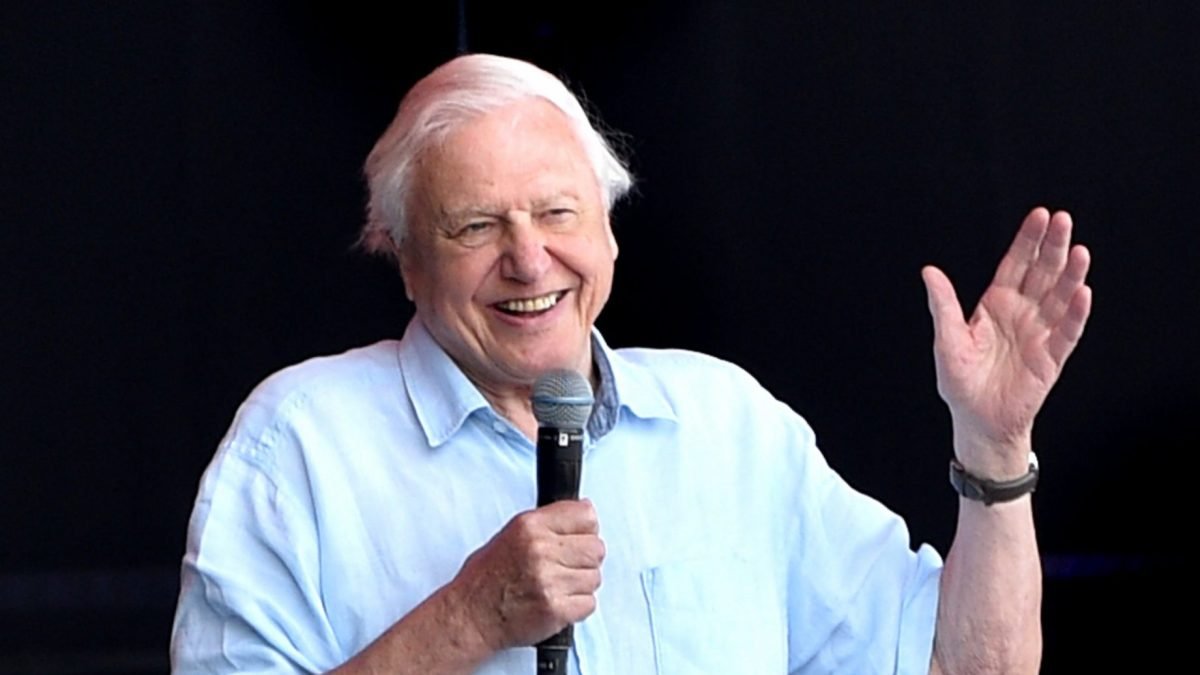

He is a creature every bit as rare as those he stalks in the undergrowth to observe. He may, in fact, be the last living example of a breed facing extinction. And so, on the occasion of his 100th birthday, his continued existence is one that must be celebrated.
Sir David Attenborough bestrides our culture like a colossus, possibly the only person who we all agree on. He is a titan of the ages.
Barack Obama once said that he is “a great educator as well as a great naturalist”, while Keir Starmer asserted that he has “done more than anyone to teach us about the wonders of our planet”. Today, as Attenborough passes his centenary, there will be many similar encomia from cultural and political figures, and it is truly remarkable that this polarised, quarrelsome world can still find someone to unite us. He is the last person on Earth that anyone has a bad word to say about.
Well, almost. The environmentalist journalist George Monbiot has been critical of Attenborough’s opinion that, in a broadcasting sense at least, were he to concentrate on the human destruction of the natural world, it would be a “turn off” on the grounds this would be “proselytising” and “alarmist”. Monbiot, however, posted in 2018 his controversial view that “for decades, Attenborough has created a false impression of the health of the living world”.
But maybe it’s because of, rather than despite, his unwillingness to be overtly political that makes Attenborough such a venerated figure. He brings joy and enlightenment, rather than politics and polemic. We may be tired of being told what to think.
But of all of Attenborough’s qualities, it is possibly his voice – as distinctive as the call of the red-legged seriema or the vocal range of the lyrebird – which distinguishes him. Unhurried, composed, classless, neither posh nor accented, precise but not self-aware, capable of conveying the life and death struggle of a lemur in calming, comfortable, respectful, sensitive tones, for seven decades it has been the soundtrack to several generations’ discovery of our planet. Our parents, our children, and us – we could all recognise that voice and immediately recognise what it signifies.
What he is conveying, above all, is wonder. At the natural world, at its kindnesses and cruelties, at its range and complexity, at its simple beauties. He is estimated to have travelled almost two million miles in his career, and has visited 90 countries and all seven continents in his quest to enhance our understanding of nature.
And yet he still finds himself in awe. Through a slight lift in his voice, a controlled change in cadence, Attenborough lets us know that what we are seeing is extraordinary. His is the wonder of a scientist who has retained an almost child-like capacity for astonishment, eschewing the performative “oh my gods” and “amazings” of others who have trodden a similar path.
That Attenborough has maintained his pre-eminent place in our broadcasting pantheon for so long is because he gives us a perspective that is not bound by political allegiance, cultural mores or indeed fashion, but by time and by geology. Set against the majesty of nature, our lives seem somehow trivial and ordinary. And that’s not a bad perspective to have these days, if you ask me.
Nature is a constant, imperilled though it may be by our destructive actions. And Attenborough is, at 100 years old, the very embodiment of that constancy and longevity. It may not be the moment to consider this, but who will be the secular saint (as Stephen Fry called him) of the next generation?
It is hard to think of someone. Attenborough is a specimen of a dying breed: a human who has dedicated himself to something bigger than himself, and, in so doing, helped make sense of the mysteries and marvels of the world. Let’s just hope he keeps going. Many happy returns, Sir David Attenborough.