
It was only three years ago that Eurovision cha-cha-cha’d into Liverpool for a spectacle that instilled the biggest sense of collective national pride since the London OIympics. The UK pledged solidarity with Ukraine, the reigning winners who’d been forced to delegate hosting duties following Russia’s invasion. Alongside other competing nations, reinforced the idea that yes, Croatian shock rockers, Czechian folk covens and Swedish pop divas performing under what appeared to be a giant panini maker can indeed bring people together. So much so that the European Broadcasting Union subsequently adopted the BBC’s slogan, “United by Music”.
Since then, however, “Divided by Politics” has become more a more fitting tagline, culminating in the biggest boycott in the event’s 70-year history. Five regulars will be notable by their absence when Eurovision 2026 kicks off at Austria’s Wiener Stadthalle tonight: joint record winners Ireland and Big Five contributor Spain, alongside the Netherlands, Iceland and Slovenia, all in protest of Israel’s continued presence in the competition amid the ongoing conflict in Gaza.
Of course, political protest at the event that prides itself on being apolitical is nothing new. In 2009, Georgia withdrew after refusing to change the lyrics to their hilariously unsubtle anti-Russia anthem “We Don’t Wanna Put In” (Put In, geddit?). Four years later, Finnish singer Krista Siegfrids challenged her home country’s laws prohibiting same-sex marriage by kissing her female backing dancer in a wedding dress. And as Israel stormed to victory in 1978, Jordanian TV cut from the final voting results to a picture of daffodils, later declaring – in a display of propaganda that would make Kim Jong-Un proud – that runner-up Belgium had triumphed instead.
Most notably, Iceland’s electro-goth outfit Hatari used their televote reveal in 2019 as an opportunity to wave the Palestinian flag, an act of defiance which the EBU punished with a fine. Since the outbreak of the conflict, though, Eurovision has discovered financial penalties are of little deterrence.

While the 2024 contest in Sweden was one of the most progressive, with a record number of openly queer acts, it was also the most politically charged. Firstly, over 2,000 Nordic artists put their names to an open letter opposing Israel’s inclusion. Then a bunch of celebs (which appeared to have been drawn randomly from a hat) including Dame Helen Mirren, Gene Simmons and this year’s unlikely San Marino competitor Boy George, signed a petition in favour of the opposite. Israeli competitor Eden Golan was forced to tone down the pro-Israel rhetoric of “Hurricane” after its original incarnation (titled “October Rain”) was deemed to reference the October 7 attacks.
As the build-up officially got underway, things got decidedly ugly. Joost Klein – the big-suited Dutchman whose happy hardcore banger “Europapa” was tipped as a potential winner – was at the centre of the first furore. Soon after challenging Golan at a press conference, he was thrown out of the final following an alleged altercation with a camera operator. As the Swedish authorities launched an investigation they later closed due to insufficient evidence, rumours started surfacing he may have been deliberately sabotaged.
Bambie Thug, the non-binary “ouija-pop” star whose entry “Doomsday Blue” deservedly achieved Ireland’s highest finish since 2000, also went through the mill. Not only did they incur the wrath of the Irish Freedom Party for making a “mockery of our national culture”, they were also subjected to an online witch hunt, forced to remove the pro-Palestine messaging scrawled on their body and allegedly subjected to repeated incitements of violence by an Israeli broadcaster. “The EBU is not what the Eurovision is,” Thug later claimed following her lack of support from the powers that be. “F*** the EBU.”
Indeed, many contestants that year talked about their Eurovision experience as if they’d returned from combat. The UK’s Olly Alexander, who’d faced criticism for signing a letter describing Israel as an “apartheid regime”, advised any future entrants to seek a good therapist. Switzerland’s winner Nemo, who has since returned his trophy in response to Israel’s participation, admitted his victory was tarnished by loneliness. Meanwhile, Norwegian metal band Gåte claimed they – alongside several other acts – were so disillusioned with the behind-the-scenes drama they nearly pulled out at the last minute. “This wasn’t the Eurovision we wanted to be in,” they said.

The EBU subsequently took measures to help reduce the toxic atmosphere, hiring on-site therapists, introducing no-filming zones and implementing more closed-door rehearsals. But if executive supervisor Martin Österdahl, who’d been heckled last time around, thought Eurovision would get back to playing happy families in 2025, he was soon made to think twice. Again, Israel’s involvement inspired a letter of protest, this time from 72 former entrants who argued they were “normalising and whitewashing its crimes”.
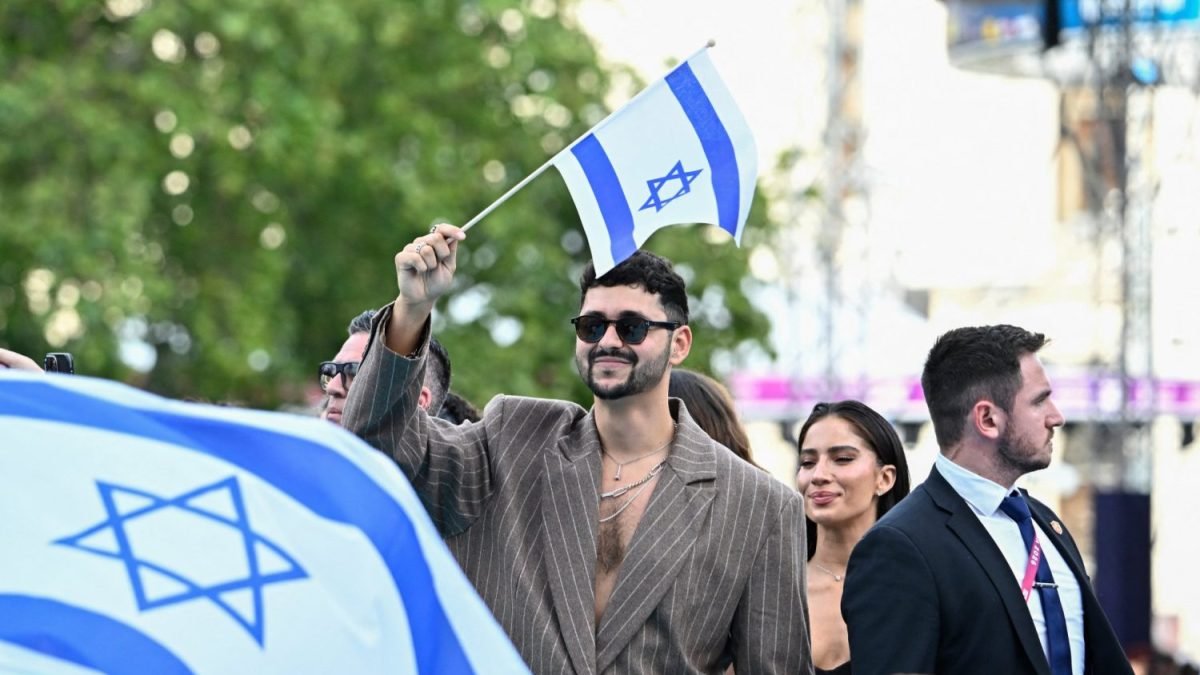
Israel’s Yuval Raphael, a survivor of the October 7 attacks who’d hid under dead bodies for eight hours before being rescued, had her dress performance rehearsal of “New Day Will Rise” interrupted by a handful of Palestinian flag-waving protestors. Anti-booing technology was reportedly adopted to drown out the jeers during her semi-final.
The EBU’s worst logistical nightmare – having to stage the following contest in conjunction with Israel – nearly became reality when Raphael’s dreary ballad (a possible non-qualifier if entered by any other country) nearly pipped Austria’s JJ and the operatic techno of “Wasted Love” to the crown. With a disproportionately massive televote, as it was in the year previously, the Israeli government was later accused of surreptitiously lobbying for international support.
Remarkably, the EBU appeared to believe issuing new regulations (restricting third-party promo campaigns – a rule Israel’s national broadcaster has already found to have broken; reducing the number of maximum votes per person; increased monitoring in suspicious patterns) to thwart such subterfuge would be enough to placate their detractors for 2026. Surely, a vote on Israel’s participation – as initially promised but then entirely ignored – would have been the obvious step?

But such naïvety – not to mention their inability to take swift (and many would say necessary) action – shouldn’t have been a surprise. The EBU initially allowed Russia to compete in 2022, only agreeing to a ban once it became clear the fallout may threaten the contest’s existence and on the recommendation of Eurovision’s governing body. On this occasion, however, Eurovision has decided to weather the storm.
The toxicity surrounding the contest appears to have spilled over into the already intense fandom, too. The negativity has been amplified in the social media age. Last year, some Croatian fans called to boycott entry “Poison Cake,” not because it was an unlistenable cacophony, but for the fact performer Marko Bošnjak was openly gay. One can only assume they’d never previously watched the contest. Both this year’s Swedish representative, Felicia, and 2025 Danish entrant Sissal received online death threats, the former for arguing that it was inappropriate for Israel to participate, and the latter over rumours she’d deliberately omitted Raphael from an online group chat.
The drama keeps coming too. Austrian 2014 winner Conchita Wurst was expected to be an integral part of this year’s show but recently announced she has withdrawn from the Eurovision circus entirely. And the UK’s first choice of contestant was apparently sent packing after the BBC discovered a series of problematic social media comments, which is why we’re now stuck with the Howard Jones-meets-Sleaford Mods racket of Look Mum No Computer.
It’s little wonder, then, that this year’s line-up feels lacking (hot favourites Finland sound like an outtake from Will Ferrell’s spoof film Eurovision Song Contest: The Story of Fire Saga), with many artists previously considering joining the madness now unwilling to touch it with a bargepole. 13 out of 16 acts, for example, who competed in the Festival da Canção, the Portuguese competition which doubles up as the national selection, refused to go to Vienna if they won.

It’s also been a turbulent period for the BBC, who were quickly forced to reshuffle their presenting team following the shock dismissal of Scott Mills. Rylan will now be joined by Angela Scanlon for the televised semis and Sara Cox for Radio 2’s airing of the final. And while chief commentator Graham Norton needn’t worry about another The Neighbourhood-style bomb just yet, audience figures are still expected to take a hit, with many longtime fans vowing to pay this year’s contest dust.
“It is not accurate to claim that Eurovision is merely an apolitical music festival,” said José Pablo López, president of RTVE, the Spanish state broadcaster also boycotting Eurovision this year. “We are all aware that the contest carries significant political implications.” Everyone, that is, apart from the EBU whose head-in-the-sand approach to the dark cloud is now threatening to engulf the once-sunny smorgasbord of pop has been as worthless as the dreaded nul points.
The Eurovision semi-finals are on BBC One tonight and Thursday at 8pm. The final is on BBC One on Saturday at 8pm.