
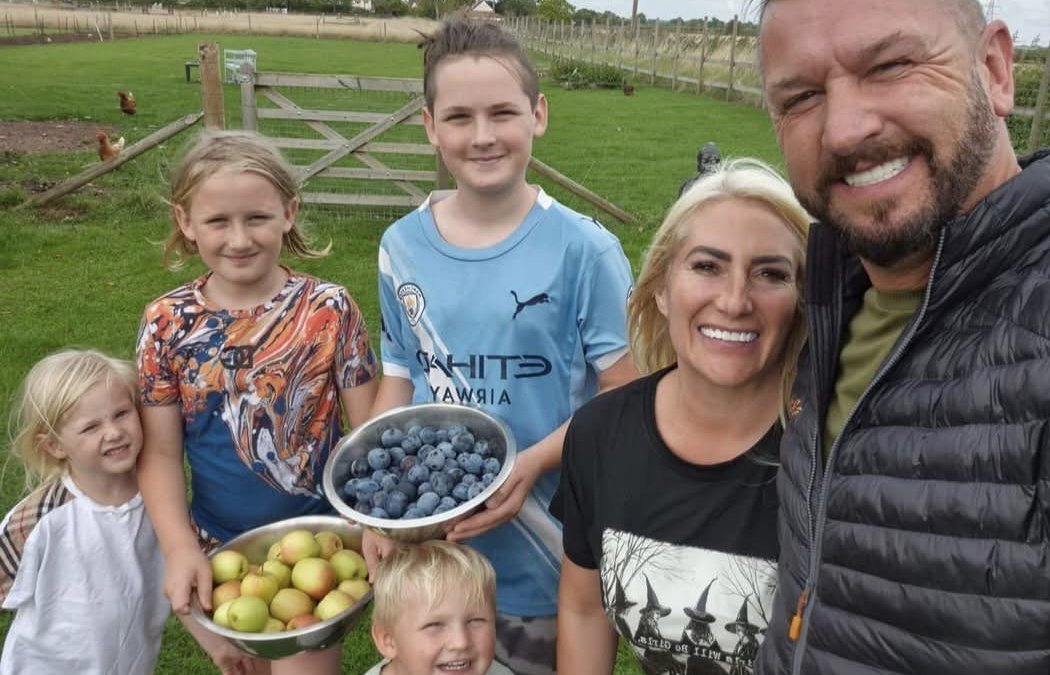
After travelling the world with the British Army, Steve Mitchell, 51, and his wife Donna returned home to the seaside town of Weston-Super-Mare, where they bought a four-bedroom house and raised their two daughters. When their youngest daughter Shannon left home to move in with her boyfriend, Steve and his wife decided to move to the countryside.
In 2020, Steve and Donna bought a two-bedroom house with a six-and-a-half-acre farm in Somerset, which gave them the chance to expand their dog daycare business.
“It was a bit of paradise because it’s in the middle of nowhere. There’s no light pollution, we don’t have any neighbours… It was just everything we were looking for… that peace, that serenity, a little bit of self-sufficiency, away from the madding crowd,” says Steve.
A year after they moved in, his daughter Chelsee and son-in-law became estranged, so she wanted to spend time with her four young children and parents in the country. With her parents’ approval, she bought a second-hand caravan from a holiday park and placed it on their land.
Each weekend, the four grandchildren would be able to play on the farm, feed the alpacas, ride their bikes and spend time with their grandparents. “We saw our grandchildren every morning, [and] every night, and it’s amazing,” says Steve.

Steve’s daughter and son-in-law soon got back together, and the family started to spend more time on the farm. It wasn’t long before they asked to live on the farm full-time. The family began to consider their options.
The idea of extending their own two-bedroom home would have cost more than building an annex. While they love spending time together, they know they also need time for themselves. Steve, who is also the owner of the personal development company Release The Best You says: “We’re both running multiple businesses. We’re both very busy. So we love to be connected with our children, our grandchildren, but we also like disconnect now and then as well,” he laughs.
As Steve and Donna lived on a flood plain, they were told by a former town planner that they wouldn’t get planning permission for a residence. But he also advised that it can take up to two years to go through the planning and appeal process. If the cost of building the annex was cheaper than two years’ rent, the family believed it would still be worth doing, especially if it meant the children had two years with their grandparents in the countryside, away from cars and light pollution.
So, in June 2023, the family installed a three-bedroom annex. It cost £60,000 to build, which his daughter and son-in-law paid for, and now, three years later, the couple who previously paid £1,800 a month for a property in Weston-Super-Mare have saved £64,000 in rent.
Steve, who served in the British Army for six years, trained as a plasterer and worked as a carpenter before he became a mindset coach. His daughter and son-in-law also owned their own building company, so within six weeks they had built a 12-metre-long and eight-metre-wide annex in Steve and Donna’s garden.
Steve was keen to support his daughter, as he knows how hard it is to get on the housing ladder. “It was tough for me and my wife [when we were starting out], because we never had a [house] deposit. We were both self-employed. Nobody would touch us. We had to take out 100 per cent mortgage, and we were paying £750 a month, interest only, on a £70,000 mortgage,” he says.
Steve and Donna also helped their other daughter, Shannon and her boyfriend, get on the housing ladder by letting them live with them rent-free while they saved their deposit.
After the family decided to build an annex at the farm, Chelsee’s husband drew up the initial plans for the dwelling and took them to an architect. They designed a three-bedroom annex with a large lounge. They installed a stylish kitchen and bathroom, added underfloor heating and covered the outside of the annex with anthracite-coloured cladding so it would blend into the landscape and match the agricultural look of the other buildings on the farm.
When it came to choosing where to place the annex on the property, as they needed to connect to the electricity and water mains for the main house, they chose a plot that wasn’t too far away from the main buildings. The family now splits the water and electricity bills between them. And as the farm has two entrances, they were able to have their own privacy by using separate driveways.
They didn’t have to make any changes to the original design: “I think the reason for that is it was designed the maximum use of space, the maximum use of materials, with the minimum impact on the land.”
As they are on a flood plain, they wanted to be as environmentally aware as possible and installed a rainwater collection system. “All of the rainwater that [comes] off the roof goes into IBC containers. We use that water for our animals,” says Steve.
The most challenging part of the build was creating a concrete base for the property to rest upon. “We had to get lots of machinery in to dig out the foundations,” he says. “You can imagine the state of the land with all these lorries and diggers, but it’s all healed now.”
Now the family is reaping the rewards of living so unusually close. Steve says: “Sometimes Chelsee might phone us and say, ‘I’m doing a big Bolognese, do you want to come down?’ Or on a Saturday morning, I might cook a breakfast and we all sit and eat that in the garden. Of course, in the summertime we have lots of barbecues.” They have always been a close family, but this has brought them even closer: “We’re very involved in our grandchildren [lives].”
The family have recently been told by the council they will need to remove the annex and the concrete base, however, it could be another year to 18 months before they must remove it permanently. As his daughter Chelsee has contacts in the building industry, her father says she already has buyers for the kitchen and bathroom fittings for when they need to dismantle the structure. The couple has now saved enough money for a deposit on their own home.
Steve is proud of what they have achieved. “I think this is a very good lesson that we’re teaching our grandchildren; you can do whatever you want to do. You just have to believe you can do it. If you want to build a three-bedroom cabin with your own hands, go and do it.”
Steve says the annex was never seen as a permanent solution. They knew the temporary building wouldn’t add any value to their own home. It was just seen as a way for the family to spend some time together.
“We’ve been very blessed. Some grandparents only see their children or their grandchildren during the holidays. We get to see them every single day,” says Steve.