
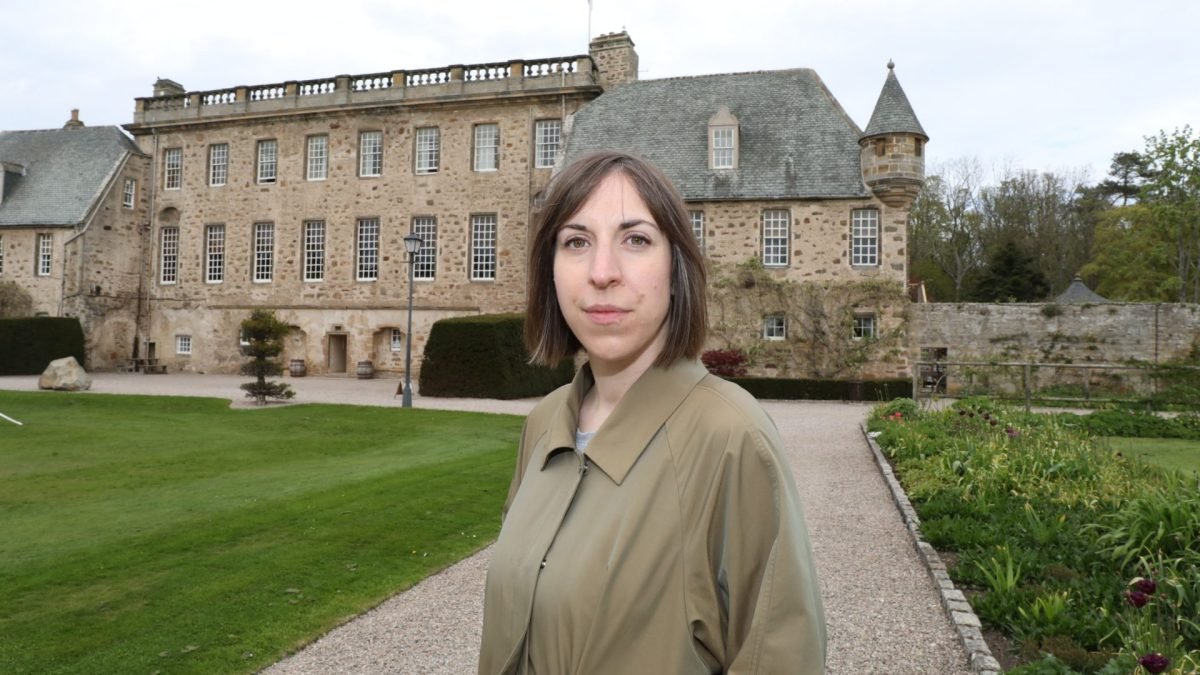
As we drive up the tree-lined path to Gordonstoun boarding school in the Scottish Highlands, I’m feeling nervous. It’s a morning in early May and the sun is beating down on the bright green grass which stretches as far as the eye can see across the school campus. Two huge swans glide along on the glittering ornamental lake, and in front of me is a colossal, stone mansion.
Although all of this looks like a scene from a genteel period drama, this academically non-selective school in the coastal region of Moray, between Aberdeenshire and Inverness, has a reputation for gruelling endurance tests. The children do 12-hour relay runs in the pitch black through muddy woodlands, and 24-hour mountain bike races in the middle of winter. I’m imagining there’s lots of discipline and rigidity, and plenty of cold showers. That sort of thing has always been my idea of hell, and Gordonstoun has a reputation for toughening up its pupils. I’m spending two days here – so are they going to try and toughen me up too?
“You’ll be pretty tired by the end,” I’m told by a staff member. “The kids here are kept very busy, and you will be too. An average school day ends at 5.30pm.” First thing in the morning – 8.30am – is hymn practice in the chapel, which takes place in a surprisingly modern brutalist building designed by a former pupil to look like an open book, but also a boat.
Sailing and seamanship is a compulsory part of life here, and Gordonstoun has its own 80-foot yacht called the Ocean Spirit of Moray, on which the pupils go on week-long voyages through dolphin-filled Scottish waters, and up to see polar bears in The Arctic. “A lot of the kids don’t realise how lucky they are at 15 years old,” a staff member says. “People would pay thousands for these experiences.” And, well, the parents do pay thousands. If you’re a boarder, the fees are between £21,365 and £23,000 per term, costing around £57k annually.

Children try everything, and learn how to fail
Looking around at the pupils with their hymn books, I’m struck by how dressed-down they are. Instead of the bow ties and boaters I imagined children at an expensive boarding school might wear, it’s all jumpers, trousers, or sports gear. The emphasis, a teacher tells me, is on practicality, on being ready for the outdoors.
Stephen Kirkwood, the head of classics who is leading hymn practice, is, however, not dressed down. I suspect he might have worn this yellow bow tie, black gown, and white fedora every day for the last three decades he’s been at Gordonstoun. The singing starts quietly, but as soon as Kirkwood challenges pupils to compete to be the loudest, the chapel is filled with teenage voices booming All Things Bright and Beautiful at the top of their lungs.
A few teenage boys volunteer to bang a drum in time to the hymns (nobody would have been seen dead doing that at my school) and there’s a playful, have-a-go feel to it all. “Everyone has to do rugby, dance, choir…we don’t give them a choice, so you get huge rugby lads doing a dance performance, and there’s no sense that it’s weird or uncool.”
Being taught how to fail is also an important part of the school’s ethos, as established by its founder, Kurt Hahn, who fled his home country of Germany to escape the Holocaust. He believed pupils should go beyond the classroom, and challenge themselves in the outdoors.
As chapel ends, Mr Kirkwood announces that at breaktime, pupils can meet him under the blossom trees to sing madrigals (a Renaissance vocal style of singing acapella) in honour of May Day. Surely, I think, no child or teenager is going to show up to that in their free time, especially now that it’s started raining. Yet, right on time, 12 or so pupils, soon joined by a smattering of staff – including the head teacher – gather under the cherry blossom to sing a medieval song about summer, in Middle-English dialect.

‘Naughty’ Prince Philip was head boy
Some of these children will later this week go off on a five-day wild camping expedition, while another tells me she will be continuing her firefighting training at the school’s own fire station. She is only 17, but might, at any time, be called out to assist with a real fire in the Highlands. “It’s really exciting,” she says, “because I can be paged even if it’s during my maths lesson, or at 3am while I’m meant to be asleep in my dorm!”
It’s this broad, adventurous school life that Prince Philip enjoyed so much during his time at Gordonstoun. He was only the tenth pupil the school had ever had, starting in 1934 at the age of 13 and boarding full-time for five years. He was ‘guardian’ (the Gordonstoun term for head boy), captain of the hockey and cricket teams, a keen sailor and member of the ‘Watchers’, which was a precursor to the school’s coastguard service. His school report called him “naughty but never nasty”, and photos in the school archive show him down at the harbour, smiling as he repairs one of the school canoes. Several teachers tell me that the man who would be the Queen’s husband, was “the ultimate Gordonstonian”.
He found it so character building, he sent his son Charles there, who was the first Prince of Wales to be educated at school rather than by private tutors. Philip also sent Prince Edward there (Edward had, in fact, just visited his old school day before I arrived) and Andrew Mountbatten-Windsor, who boarded from the age of 13.

Philip’s daughter, Princess Anne, wasn’t eligible to go to the same school as her brothers, as the institution was all boys until 1972, but she sent her son Peter Philips and daughter Zara Tindall there. I am shown King Charles’ old room, which is now inhabited by the head girl, or ‘guardian’. There is a little sofa, with colourful cushions, and a kettle – head-girl privileges – alongside Charles’ old dressing table, and his desk, over which pupils have since doodled drawings and messages to their friends.
If Philip found fun and stability at Gordonstoun, his son Charles had a more complex time there. In a letter home, he wrote: “It’s such hell here especially at night. I don’t get any sleep practically at all nowadays … The people in my dormitory are foul. Goodness they are horrid, I don’t know how anyone could be so foul…”
Charles has since played down his reported dislike of his school years. During a House of Lords speech in 1975, he said: “I am always astonished by the amount of rot talked about Gordonstoun… it was only tough in the sense that it demanded more of you as an individual than most other schools did – mentally or physically.” He also told The Observer; “I didn’t enjoy school as much as I might have, but that was only because I’m happier at home than anywhere else.”

‘Some parents are very involved – but there are some we’ve never met’
The head of the prep (junior) school, Cath Lyal, is originally from Glasgow, but she moved up to Moray with her husband Andrew, who was a house master at Gordonstoun, as well as a former pupil. Cath – whose older child attended the school, and whose younger child is in her final year here – is in charge of the welfare and daily lives of the youngest pupils at the school.
She must see a lot of homesickness, I say. “We would expect them to feel a little bit homesick, at first,” she says, “but we keep them busy, and at nighttime, which is usually when it happens, we are there for hot chocolate and a chat. We want them to understand that homesickness is ok, it won’t last forever.” Looking after the children is a seven-day-a-week, 24/7 operation. Cath’s own house and garden adjoins the boarding house. “It’s definitely a way of life, it’s not somewhere you’d come if you want to clock on and off in a normal way. I do have times when I’m not on duty, though.
“Actually,” she corrects herself, “I don’t like the term ‘on duty’ because I think that it makes the children think that it’s a job. And for many of them this is their home. I have a different relationship with these children than another staff member at another school would – they’ll give me a hug when they see me. But there’s still that politeness and respect.”
A little girl – no more than nine – walks over to us and asks Cath whether she’s allowed to go and get the tortoise from his enclosure. “Yes, sweetheart, get him and put him down on the ground,” she replies, “and then wash your hands.” The girl nods, grins, and skips off. “There was a child,” Cath says, “who we found in her dorm one night with snails down her arm, chatting away to them for comfort when she was homesick. I had to be a killjoy, and take them away.” She adds, with a laugh, “so what did I do? I went and got them a tortoise instead”.

I go to look inside the dorms. Each one has three or four children living in it, with each of their names on the door. Down one end of the house are the girls, down the other end, the boys. Inside one of the boys’ dorms are three newly built, pale-blue single beds, two with football-themed duvet covers, and one covered in stars and rockets. Rugby boots, and water bottles are scattered under posters of cartoon characters blue-tacked to the wall.
In the corridor, a teacher – known to the children as ‘matron’ – is organising bags of clean washing, which the children are expected to put away. There is a whiteboard with notices, and reminders on it, including a list of names of children who need to tidy their rooms. “Some of our parents are very involved in their children’s lives,” says Cath, “so they’ll come to drop them off, they’ll come and visit, they’ll be on the phone. But we have other parents who I’ve never met, because they just send their children over… and they’re not around.”
‘A nine-year-old arrived by helicopter, head to toe in Burberry’
Children of great privilege have attended, such as David Bowie’s son Duncan Jones (he was miserable there, and expelled), Sean Connery’s son Jason, as well as all sorts of barons and dukes. One student in year 13 from the Cotswolds tells me she came here because her two older brothers and dads are OGs (Old Gordonstonians). “It’s just normal in our family,” she says.
There are children from over 40 different countries, including Dubai, China, Russia, and Germany. But each boarding house limits the number of children from the same country in one form, to avoid cultural silos. A Scottish pupil in her last year of school gives me a tour. “I live locally, at home with my family,” she says, “but I often don’t leave school until 9 or 10 at night because I stay and hang out here with my friends.”
Cath, head of the prep school, says that the focus on self-suffiency can be a shock to the system. One of her pupils arrived here at the age of nine via private helicopter. “She was dressed head to toe in Burberry,” says Cath. “Her form tutor was helping her unpack her cases, suggesting she organise this drawer for sports clothes, this one for shirts, this one for jumpers…and the child said, ‘no, I think I’ll organise them by designer instead’. To be fair, she doesn’t do that now. We’re not that kind of place.” The school is now more expensive than it was, due to the government’s introduction of 20 per cent VAT on private schools. “That has made some parents more challenging,” she says, “in terms of what we offer and provide.”
Yet, of the just under 500 pupils currently at the school, 34 per cent have a means-tested financial assistance to attend the school, with most grants between 10 and 25 per cent of the fees. A minority of families have 100 per cent of fees, plus travel expenses, funded by the school. Military families – the school is next to an RAF base – receive financial assistance, too. Financial assistance has remained steady since the imposition of VAT.
“Here, nobody talks about money,” says the director of admissions Chris Rose, who used to be COO at Midlands rugby club The Leicester Tigers. “There’s no sense of being better than other people because of your background,” he says. “When you’re out sailing, or fighting a fire, nobody knows or cares whether you’re the son of the Monaco royal family or a kid on a bursary from Northumberland.”
This is a topic close to the heart of the head, Simon Cane-Hardy, who started at Gordonstoun in 2023, after leaving his post as deputy head of Prior Park College, a boarding school in Bath. In his early 40s, he is athletic (has coached rugby, loves cricket), friendly and approachable. “Simon makes the girls blush,” one admin staff member chuckles to me earlier in the day.
‘Private education should be accessible to working families, not just the wealthy’
He moved here with his wife Helen and three children, all of whom attend the Gordonstoun prep school, and the whole family lives on site in an old, beautiful country house. “It’s a really tough time for the [independent school] sector,” says Cane-Hardy. “It’s [VAT] put a huge burden on schools and therefore, onto parents. I know that, like lots of other schools, we worry about remaining accessible to as many people as possible.

“I was a recipient of a scholarship and bursary that allowed me to go to an independent school for six form”, he says, “and I would not have gone to the university I went to and achieved the results I did, and met the people I did, and had the opportunities I’ve had in my life, without that experience. King Charles in his first year here shared a room with two local boys from a farm. And I think people outside our school appreciate that level of diversity we have. I would also say, though, that I don’t want Gordonstoun just to be for the very wealthy or students on transformational bursaries. How can we ensure that independent education is accessible to that group in the middle, those professional families with both parents working?”
As the head of a boarding school that educated three generations of the royal family, what are some of the misconceptions Cane-Hardy believes people have about Gordonstoun? “They watch The Crown, and they think it’s going to be brutal here,” he says. “It’s nothing like that. This is a really modern school. It’s a happy community. When things go wrong, we’ll deal with it really well. That’s not to say that things haven’t gone wrong in the past, but today the pastoral care is of an extremely high quality.”
The “mistakes” Cane-Hardy is referring to are findings of historic child abuse. In 2024, the Scottish Child Abuse Inquiry (SCIA) ruled that child abuse at Gordonstoun School was allowed to flourish unchecked for decades. Lady Smith, chairwoman of the SCAI, concluded that children who boarded at both establishments were exposed to risks of sexual, physical, and emotional abuse – and that for many those risks materialised. In 2018, former Gordonstoun teacher Andrew Keir was jailed for lewd acts involving pupils at swimming sessions between 1988 and 1991, and Smith said six other teachers sexually abused children between the 1960s and 1990s.
When the findings were published, the principal of the school at the time, Lisa Kerr, said: “It’s been devastating to see the impact of the abuse at Gordonstoun has had on them. I’m deeply sorry and apologise unreservedly for the fact they were failed by Gordonstoun and those charged with their care.”
How does a school move on from something so damning? Cane-Hardy, who joined after the inquiry, says the school was “quite right” to apologise. “There are things that as the head of the school today, you look back on and think, ‘gosh’, and we’ve talked to our pupils about it. You acknowledge that was wrong, you don’t make excuses for it, but fundamentally, you make sure that your students today are supported, happy and achieving their potential.”

Outside Cane-Hardy’s office, there is a flurry of excitement. A huge walrus has been spotted sunning itself on a boat at the nearby harbour, and the year eights are out there now, on the canoes. “I’ve got a risk assessment about what to do if we see a killer whale on the water,” jokes Cath, head of the prep school, “but now I’ve got to update it and include walruses!” On the grass, near one of the two golf courses on campus, the sound of bagpipes starts up, as the school band begins their rehearsal.
As my two days at Gordonstoun comes to an end, I am given a bag of branded merchandise by the head of marketing Caroline Overton. A small, squishy boat with the school’s logo on the side for my toddler, a water bottle, a notepad, a key ring. There are big moves to roll out the Gordonstoun brand internationally, with branches of the school opening in Abu Dhabi in 2026, and in Wakayama, Japan in 2027. It is a business move that lots of big-name British boarding schools, such as Harrow, are also making.
I wonder whether these new branches – thousands of miles away from The Highlands – will achieve the otherworldliness that I have felt at Gordonstoun. Will those boarders also have their mobile phones locked away all day, so they can focus on sailing, shooting, and singing madrigals under the cherry tree? Will there be this old-fashioned boarding school life – matrons and Sunday chapel service – mixed in with a progressive approach to learning beyond the classroom? Will all the teachers live on site and send their own children there, buying into the Gordonstoun ethos with such fervour that it feels almost religious?
As we drive away from the school towards Inverness airport, past the blindingly bright yellow rapeseed crops and whisky distilleries dotted around the Moray landscape, I remember an anecdote the former head teacher – now school archivist – Richard Devey told me earlier that day. “There was a pupil who was found brewing his own beer,” says Devey. “And he was rusticated [suspended]. But as he was driving away from the school, there was a big crash in front of him, and he leapt out of the car. And because of his work with the school fire service, he was able to direct everyone in terms of what to do, and how to help the injured. He was still rusticated, because he’d broken the rules – but he was also given an award.” As he shows me an archive photo of Prince Philip doing the high jump in 1934, he adds; “There’s just something about Gordonstoun pupils – even the weakest. You meet one, and you just know they’ve been educated here.”