
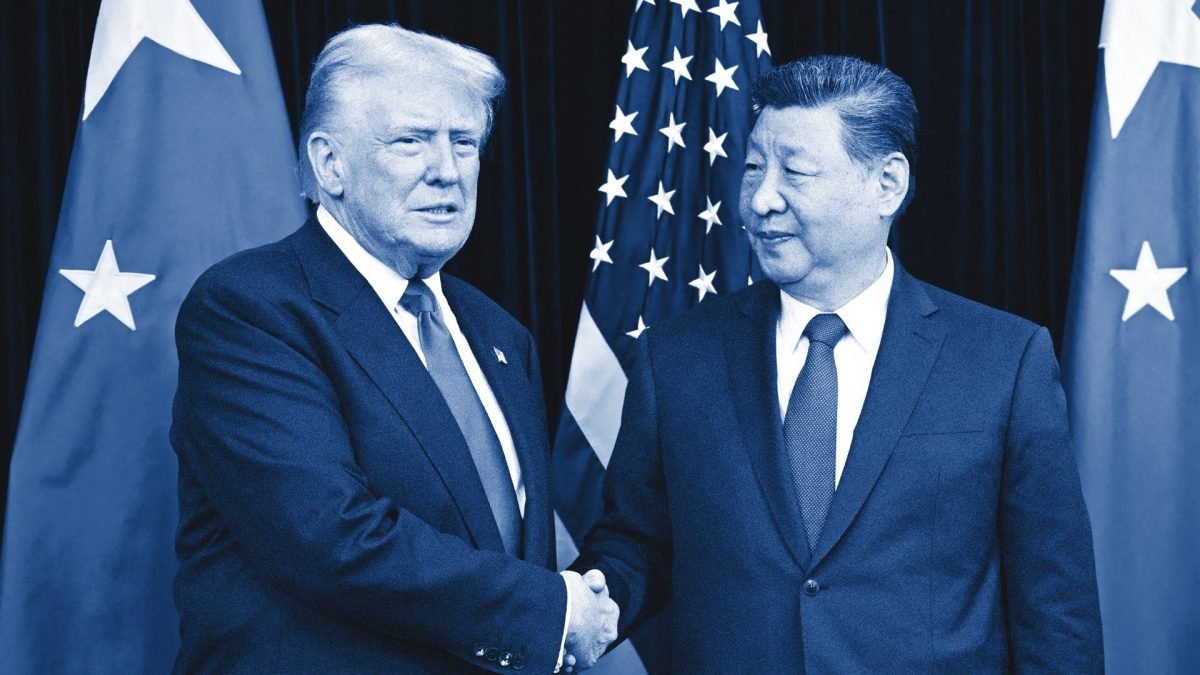

Only a few months ago, the prospect of a summit between Donald Trump and Chinese President Xi Jinping looked likely to be a bruising confrontation. Last year, after Washington had imposed tariffs on Chinese goods that reached as high as 145 per cent at one stage, rhetoric on both sides hardened sharply. For many, it looked like the start of a new chapter of an existential clash between the world’s two superpowers, one that looked increasingly likely to result not only in economic but also in military confrontation.
The fact that Peter Navarro, one of Trump’s trusted advisers, has written books called The Coming China Wars and Death by China, seemed to provide a clear indication of the threat posed by Beijing as seen from the White House: China was no longer being described merely as a competitor or rival, but increasingly as a systemic adversary whose rise had to be checked, slowed or contained. Combined with growing tensions over Taiwan, export controls on advanced semiconductors, disputes in the South China Sea and deepening arguments over critical minerals and supply chains, assumptions about the direction and nature of US-China relations seemed to become darker than at any point in decades.
Trump has tried to navigate the rising anxiety about China, which is one of the issues that has united Republicans and Democrats in the US for the best part of ten years. During his first spell as US President, Trump was careful to underline that he had a good relationship with his Chinese counterpart: “The relationship is very special, the relationship I have with President Xi,” he said at the G20 meeting in Buenos Aires, Argentina, in 2018. “I think that is going to be very primary reason why we’ll probably end up – end up getting something that will be good for China and good for the United States.”
He has consistently expressed his admiration for Jinping, even when he was out of office. “I very much respect President Xi”, he told one interviewer while on the campaign trail in 2024. “I got to know him very well and I liked him a lot. He’s a strong guy, but I liked him a lot. I respect him.” Just before the election, he went further. Jinping, he told Joe Rogan, is “a brilliant guy. He controls 1.4 billion people with an iron fist. He’s a brilliant guy, whether you like it or not.”
To his detractors, this was yet another sign that the US President has a soft spot for autocrats and dictators. A better way to understand Trump’s approach is that he is signalling to Beijing that he is keen to keep the door open, to find a way to work through problems and to find a modus operandi that both countries can live with. Certainly, this is how things have been understood in China. After a meeting between the two leaders in Busan, South Korea, last October, Jinping took a similar line. “China and the United States should be partners and friends,” he said. “Given our different national conditions, we do not always see eye to eye with each other and it is normal for the two leading economies of the world to have frictions now and then.”
This does not mean that the anxieties that both countries have about each other’s motivations, ambitions or capabilities have dissipated. Mistrust is not only mutual but deeply embedded at the senior level to the point that emollient words and friendly photo opportunities can only do so much to mask it. At the moment, however, it suits both sides to make this week’s summit as friendly and constructive as possible.
For the US, the opening of Pandora’s box that has followed the attacks on Iran means that, as well as being preoccupied elsewhere, there is a need to replenish heavily depleted weapons stocks. That means that a moratorium with China is helpful, as is a loosening of Beijing’s tight controls on the export of rare earths and critical minerals. Trump has been messaging his intentions accordingly. Last month, he posted on Truth Social about the summit: “President Xi will give me a big, fat, hug when I get there in a few weeks. We are working together smartly, and very well!”
Trump cannot afford to pick another fight at a time when the closure of the Strait of Hormuz has put pressure not only on oil supplies but also on fertiliser, helium, and the global economy as a whole. As such, it makes sense to make concessions to Beijing and to present the summit as a meeting of world leaders who are able to put differences to one side rather than looking to escalate tensions.
That works well for Jinping, too. The optics of Washington treating China as a peer are good for the latter’s global stature. While better insulated from the oil crisis than some others in Asia, the economic shockwaves that flow from the events of the last few months bring risks to China’s export model, as well as to weak domestic demand. But because of the Gulf, Jinping goes into this summit with greater room for manoeuvre than seemed likely only a few months ago.
That is why the meeting is likely to produce a set of carefully calibrated announcements designed to show that cooperation remains possible. The United States is expected to push hard for major Chinese purchases of American agricultural goods – especially soybeans, poultry and beef – as well as Boeing aircraft, all of which would allow Trump to present the summit as evidence that his tough approach has produced concrete economic gains for American workers and farmers.
China, meanwhile, will seek movement on export controls, semiconductor restrictions and investment barriers. Beijing has repeatedly argued that attempts to isolate China technologically are ultimately self-defeating and that decoupling the two economies is not in either country’s interests. As such, the summit will involve handshakes and smiles and good news all round.
That does not mean that it is all good news. Few in the US have any illusions that competition with China is intense. However, over recent months, there has been a shift in thinking in Washington as the focus has moved from trying to stifle and manage China to outrunning it. That means concentrating on sectors where the US retains advantages – in energy, for example, but also finance, innovation and, above all, artificial intelligence and advanced digital systems. As a key policy document released last year put it: “The United States is in a race to achieve global dominance in artificial intelligence (AI). Whoever has the largest AI ecosystem will set global AI standards and reap broad economic and military benefits. Just like we won the space race, it is imperative that the United States and its allies win this race.”
That helps explain why Apple CEO Tim Cook and so many major technology executives have become increasingly central figures around Trump and his administration. They are not peripheral actors in this contest; they are integral to it. The competition that will define the 21st century is not simply about tariffs or shipping balances. It is about computing power, data infrastructure, AI systems, semiconductors and technological ecosystems.
This week’s summit is a staging post in a complex relationship between Trump and Jinping. The tensions that have built up over the last decade have not disappeared, nor will they be resolved by warm words or choreographed agreements. But after months in which confrontation appeared not only likely but perhaps inevitable, the significance of this meeting lies in the fact that both sides now seem to recognise that the costs of escalation are too high. For all the rivalry, neither superpower can afford for the relationship to fail completely – especially now.