
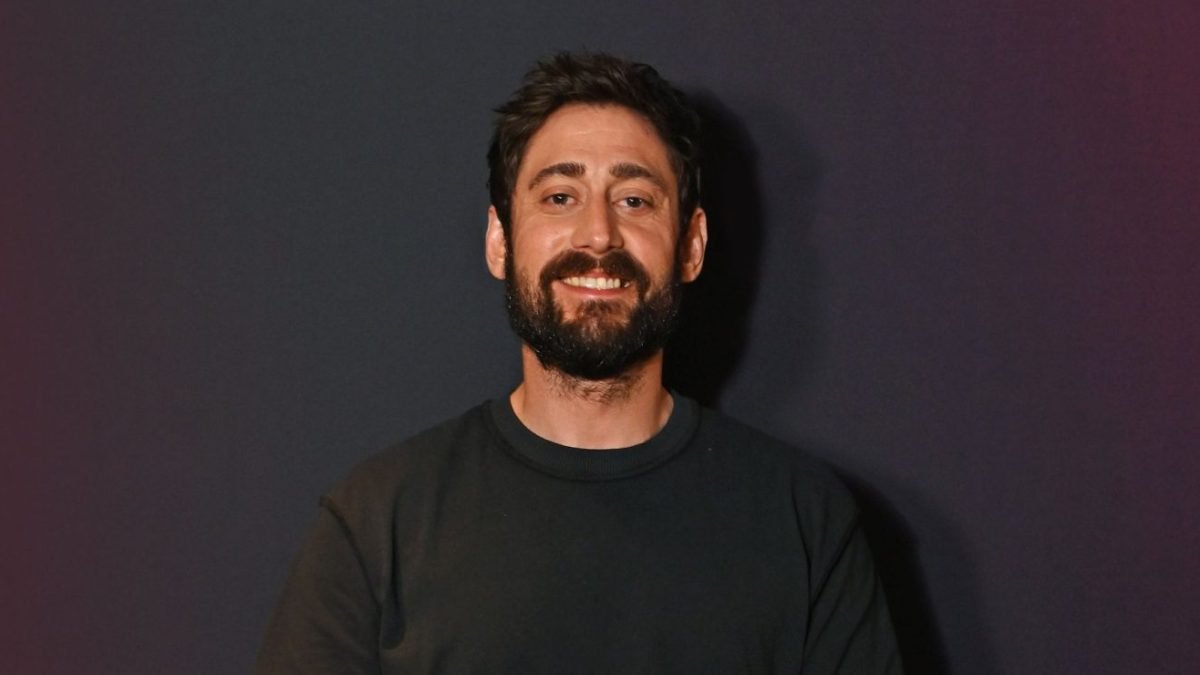
“I’ve never been good at the old ‘single tear’ scenes,” says Michael Socha. “It’s all-or-nothing for me. Once I start crying, I’m gone. I have to ask directors: ‘Do you mind if you try to get what you need from me in one take?’ Because once I start, I’ll just cry and cry until whatever was making me sad doesn’t make me sad anymore. I can’t repeat it.”
Playing chaotic casino manager Matty in the BBC’s gritty new drama, The Cage, opposite Sheridan Smith, Socha, 38, found himself in one particularly emotional scene “where I just bawled and bawled. It was really difficult.” He shakes his head. He finds such uncontrollable emotional unburdening, in the public context of a film set, “not always the most pleasant… but unsurprisingly therapeutic.”
Socha’s ability to tap into raw, unfiltered emotion is what helped him make his mark aged 16, playing the teenage skinhead Harvey in Shane Meadows’ 2006 film and the brilliant subsequent TV series This is England. “Shane wasn’t looking for trained, disciplined actors,” he recalls. “He was looking for energy, unpredictability. And that’s what he got, every day on that set.”
There’s still a flicker of cheeky-charmer kid in Socha’s demeanour. He apologises for repeatedly sliding back on his chair – chin disappearing into the collar of a camo hoodie – as he chats over video. It gives him an endearing back-of-the-class appeal.

“I was a naughty little kid, not bothered about school, where I was probably a distraction,” he says. As a working-class lad, born and raised in Derby, he was a rebellious pupil who often bunked off. “Not because I thought I was going to be a professional actor,” he says, laughing. “By the age of 14, I just realised there was a certain path that was accepted for kids like me. I knew I wasn’t going to university – although my mum would have loved that. I knew I was going to graft on a building site and over the years I’d acquire a two-bed flat and a Staffordshire Bull Terrier.”
It was Socha’s mum, Kathleen, who nudged him towards drama. “She knew it was a brilliant outlet for me, and took me away from the shit I was in outside of school.” He’d wanted to play the lead in a primary school production of Bugsy Malone – “I really wanted to be a gangster” – and was gutted to be cast in a smaller role. “The teacher didn’t like me,” he shrugs. But his mum found out a local theatre group was doing the same show and sent her son along to audition.
“When I got there, I met all these musical theatre kids who spoke differently to me. Their parents were getting them to sing scales. I found it really difficult being in that environment.” He grins. “Then I got the part and I was ecstatic.” He settled into a groove at the Derby Playhouse Youth Theatre, where he was “a bit of a novelty among all the jazz hands kids, but I found my place there. I was playing princes and having fun.” He also got involved with the Television Workshop in Nottingham (the free drama group where Samantha Morton and Vicky McClure had also earned their stripes) and although he left school with no GCSEs, he blagged his way onto a performance course at college.
About a year before he was cast in This Is England, his dad died of an alcohol-induced heart attack. He had by then separated from Socha’s mother (who lived with Michael and his younger sister, fellow actor Lauren Socha, in a different part of town). In The Cage, his character Matty is also an alcoholic who funds his addictions by skimming money from the casino. Cautiously – because I know he doesn’t like to discuss his personal life – I ask if Socha drew a little on his father for the role and he scrunches his face and gives me a “Yeeaaah,” before deflecting with generality. “But I grew up in a world where alcohol and all those issues were so prevalent, whether it be my dad or, I don’t know, friends and family.”

To get into the part of a casino manager, Socha spent time in real casinos where staff took him under their wing and showed him the ropes. While never a man who’d go to a casino expecting to make money, he has always enjoyed playing cards. “I used to play three-card poker with my family as a kid, and then Texas hold ’em with my mates.” As an actor, is he better at bluffing? “I don’t know. I grew up with a bunch of blaggers. I think my mates can see right through my bullshit.” They still encourage him to muck about: “I don’t know if I should admit to this, but they challenged me to say a couple of words when I was on The One Show the other night and I did it. I said ‘hippopotamus’.”
He’s also quite distractible. “I was at a medical recently and the doctor said I might be ADHD, but I don’t know. I asked what would happen if he diagnosed me and he said: ‘We’d prescribe you some drugs,’ and I said: ‘I don’t want any drugs. I’m sweet’.”
His restless brain allows him to keep tabs on everything happening on set, to which he never takes his phone. He recalls the early days of filming This is England. He had “no clue” what was going on but quickly cottoned on to the fact that only a small percentage of time was taken up acting, so he zoned in on the chippies, the sparkies and the grips, asking questions, studying their activity. Right now, he’s shooting The Witch Farm, a dramatic adaptation of an episode of Danny Robins’ Uncanny podcast about a haunted farmhouse in the Brecon Beacons, and tells me that “whether he knows it or not, I’m fascinated by the grip – Bobby – on this shoot. He just looks so cool, so competent and I’m watching from afar.”
Socha’s need for “the buzz” of real people is what allowed him to sack off Hollywood after playing Will Scarlet, The Knave of Hearts, in the fantasy series Once Upon a Time in Wonderland between 2014 and 2015. Because the American show aired on Disney-owned channel ABC, it was, at the time, seen as a big, shiny career move. But he later told the Guardian he didn’t enjoy the experience and ended up being underused and under-stimulated while living out in Canada away from his friends: “The first year I was fine. I was working a lot. The second year, I lost my mind.”

Although he stresses that his career is one of “peaks and troughs”, he’s got a terrific, steady CV that includes playing a werewolf in Being Human, an anxious father in Chernobyl and the half-alien border guard lead in The Aliens. You’ll have seen him in films such as The Unloved, Papillon and Stone Roses drama Spike Island. His acting is often comic – see him larking about as beer-swilling Richard III in the music video for Kasabian’s single “III Ray” (2017). “That’ll be the only time I play Richard III,” he jokes.
But I suspect he’s played more than his share of troubled souls and wonder if some of this is down to his hangdog eyebrows. “My obliques? Yeah,” He says. “I completely agree. You know, even when I’m not feeling sad, I look sad. I’ve got resting sad face.” Has he tried looking jollier in his headshots? “It was something I considered for a bit. But f***ing hell, I think as an actor you’ve not got to be scared to look ugly.” He tugs philosophically at his sleeves. “I’m not beautiful enough to be vain.”
This is what allows Socha to let himself freefall into those big crying scenes. “Five years ago, I got into this breathing meditation thing,” he says. He attended a course “sort of based on the Wim Hoff stuff”. During the first “breathing cycle”, he found the practice of breathing and holding his breath as instructed “, f***ing mental, and I got really self-conscious” But on the second cycle, he cried: “I don’t know why because I didn’t feel sad but the tears just kept coming.” On the third, he felt “just blissful, amazing.”
Socha shakes his head in amazement. “I’d released something. Got rid of it. Just sort of exorcised it.” And crying on set is like that? “Yeah, yeah. Sometimes you don’t always realise what sort of delicate situation you might be in with your feelings. So I sometimes look forward to those emotional scenes. And I find that at the end of those days I have a great night’s sleep.”
‘The Cage’ continues on Sunday at 9pm on BBC One. The full series is streaming on BBC iPlayer