
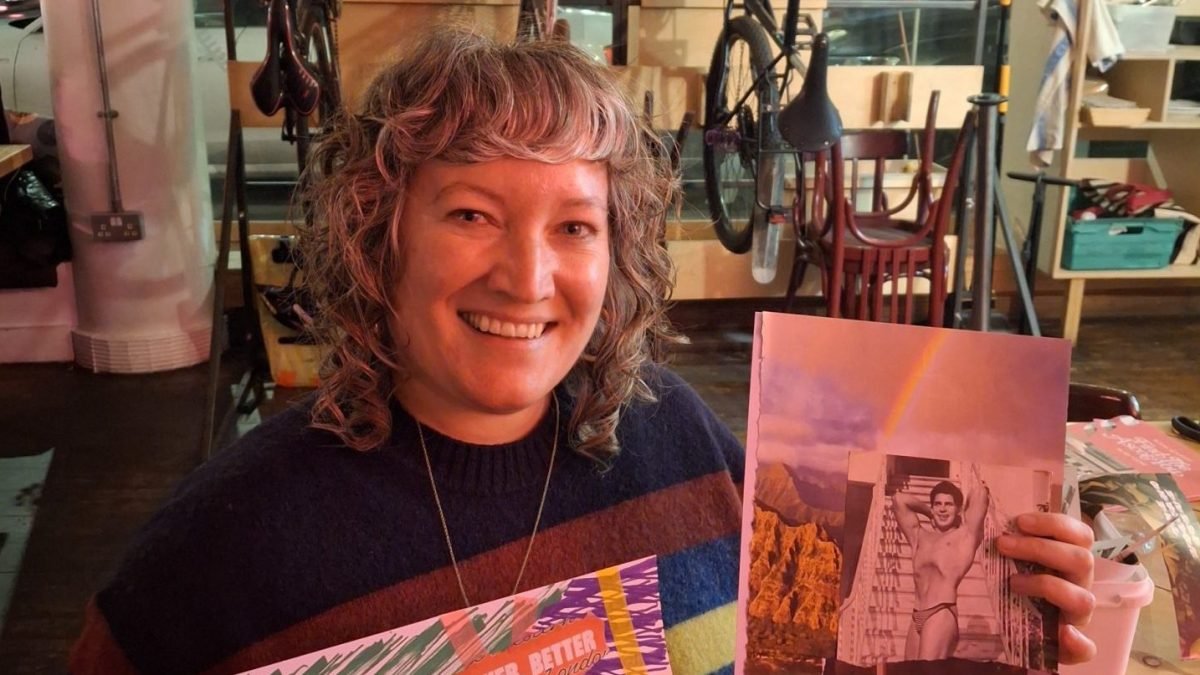
I’m holding up an A4 sheet of card covered in streaks of Posca paint resembling absolutely nothing with a giant smile on my face. I’ve spent the last 15 minutes smearing lines across the page with the enthusiasm and colour palette of a toddler, while chattering away to an award-winning artist who is largely successful at hiding his disdain for my creation. My finished piece might not give Bridget Riley any sleepless nights, but that’s not the point: the activity is fun for fun’s sake – perfection isn’t part of the equation. In the past, I’ve been reluctant to embark upon artistic endeavours because of my perceived lack of skills, but this feels like a reversion to pure play, something we rarely do as adults. I feel gleeful, carefree and exhilarated – like I’m a kid again.
I’m at Airplane Mode – No Phone Zone, a monthly, free, digital detox social event held at Eat Your Greens, an organic restaurant and wine bar in Leeds, that’s decidedly more down-to-earth than it sounds. As well as serving up some top-notch plates of food, it has also established itself as a space for connection, creativity and cultural interchange, with regular DJs and events. And it’s just one of a number of spaces opening up across the globe in which attendees voluntarily choose to surrender their digital devices for a few hours with the aim of connecting and creating.
Tonight’s activities include a collaging session, Posca painting and lino printing. Keen to make the most of my evening, I arrive early where I’m shown to a large table stacked with magazines, cuttings, scissors, glue sticks and card. I’m joined by four other people, a group that grows over the next few hours to nine. We’re given some general guidance and start cutting. While some groups physically confiscate phones, attendees here place their devices out of sight; we’re all here for the same reason: to take a break from our phones.
And goodness knows we need it. I’ve long thought that mobile phones are the best and worst thing to happen to humanity, but lately, I’ve been increasingly erring towards the latter position due a recent spike in late-night scrolling. The increase in our phones’ intelligence – to track sleep, steps and heart rates, identify plants and flowers, share photographs with the world, translate languages, provide real-time traffic and navigation – starkly corresponds to our increased dependency upon these hunks of metal and plastic. Mobile phones have become omnipresent and accompany us everywhere: bed, the lavatory, hospital wards, the cinema, funerals, weddings and during exercise. While they’re an indisputable source of information and connection, they can often feel like they’re monopolising our precious time and attention.
A major study by Ofcom in December found that people in the UK now spend an average of four hours and 30 minutes online every day, 31 minutes more than they did during the pandemic. And a recent study by the University of Manchester found that “passive” use of social media, such as doomscrolling, is linked to higher loneliness. We know that mobile phones are designed to be addictive and we’re aware that many of us are spending too much time with them, but breaking the habit seems harder to achieve.

As the night progresses and the room starts to fill with fellow digital detoxers, diners and drinkers alike, conversation organically develops with my fellow crafters. Rather than the awkward exchanges that can sometimes occur with strangers, it feels effortless and low stakes, particularly as our focus is largely on our creations. We’re forced to slow down, which seems to soothe overstimulated nervous systems adapted to switching between screens every four seconds.
During a discussion about a film with a new acquaintance, I automatically reach for my phone to pull up Letterboxd before I pause and remember why I’m here. With this exception, I feel liberated without it. Fellow attendee, Anna Courtier, 25, feels the same way. “I’m very dependent on my phone in my daily life – it comes with me everywhere I go,” she tells me. The prospect of putting her phone away for a few hours was one that appealed. “I stare at a screen all day for work, so it’s nice to get fully immersed in something for once. And after five minutes, I didn’t think about it.” She thinks that society would benefit from more phone-free spaces. “I think it helps people connect more,” she says. And the creative element was also a draw: “It takes your mind off everything,” she adds.
Another participant isn’t as committed, however – I watched wide-eyed as she pulls out her mobile phone to take a picture of her work. “I did take a few sneaky pictures,” Louise Mortimer, 39, admits. “I was like, ‘I hope no one tells me off’.” She’s previously attended other events where phones have to be switched off, saying “any opportunity to put it away is good for me”. She adds: “I think we’re way more connected [through technology], but underneath we’re more disconnected than ever. The opportunity to make human connections, put your phone away, actually make eye contact, go a bit mute and just lose yourself in something is very important.”
It’s a sentiment that also inspired Dan Palmer, the brains behind Eat Your Greens, to establish Airplane Mode. “It felt like everyone was getting a bit fed-up of being glued to their phones – it’s so easy to get sucked into doomscrolling,” he tells me. “We also run a chess club here and built a really nice community around that. Community is so important and community spaces just don’t exist anymore. Giving people the opportunity to come down and do something a bit different, get creative, have a chat, meet new people and make friends was a no-brainer.” The first session involved simply putting out some art materials, books and puzzles out before developing into workshops. “We just saw people queuing up to do the workshops,” he smiles. “It’s funny… you hate school and then as soon as you leave, if there’s any sort of teaching or creative environment, people just jump back into it.”
I feel grateful to have grown up in a pre-mobile phone era. I didn’t get a mobile phone until I was 20 years old – and it was another 13 years before smartphones became mainstream. I still love what my mobile phone enables me to do, but the more times I glance around on public transport, in a bar or restaurant and see the majority of people glued to their devices, their bodies folded like Anglepoise lamps, the more despondent I feel. I’ve spent years defending such people – they might be reading a book! Communicating with friends! Playing a game! – but I do wonder how many in-real-life interactions are lost while we’re all staring dead-eyed at our phones. But events like this make me feel hopeful and serve as a welcome reminder that, in a technologically dominated world, human connection still has the edge.