
Donald Trump‘s Defence Secretary has claimed that the US can continue the war beyond today’s 60-day deadline without authorisation as the President weighs “powerful” new strikes and ground operations against Iran.
Pete Hegseth told Congress on Thursday that Trump was not bound by a law requiring presidents to seek congressional authorisation to continue a war beyond 60 days because the current ceasefire with Iran had paused the clock
The War Powers Resolution means a president must start withdrawing forces and seek approval from Congress to continue a military campaign after 60 days. Today marks 60 days since Trump launched the war on 28 February alongside Israel. The President can also request a 30-day extension.
“We are in a ceasefire right now, which our understanding means the 60-day clock pauses, or stops, in a ceasefire,” Hegseth told senators on Thursday. He declined to answer when asked if he would seek authorisation to continue. On Wednesday Hegseth denied that the US was “stuck in a quagmire” in the Middle East during a combative appearance before the House Armed Services Committee.
Trump is receiving briefings from military chiefs on options to force a change in Iran’s position, including “short and powerful” strikes or deploying ground forces.
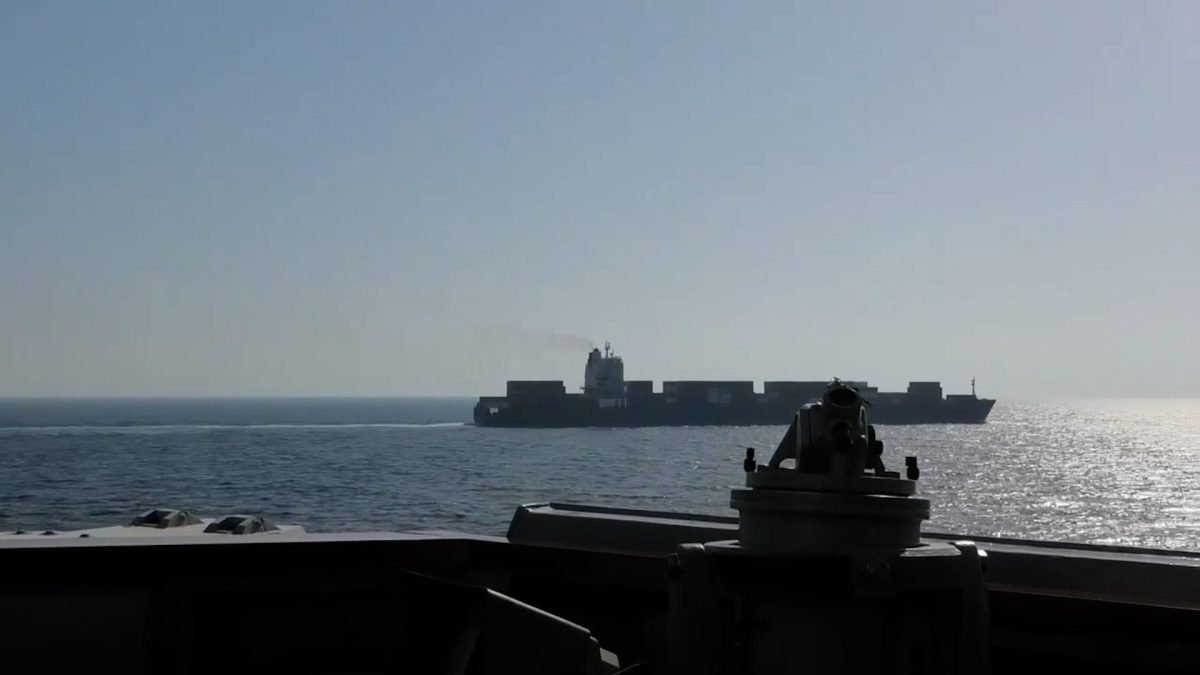
It has fuelled speculation that the US is preparing for possible fresh military action as the Strait of Hormuz remains under a blockade and oil prices surge to a four-year high.
Trump has insisted the US naval blockade of the vital shipping route will continue as long as it takes for Iran to make a deal, and is said to favour a drawn-out siege.

But Thursday’s briefing, first reported by Axios, suggests he is seriously considering resuming major combat operations, with the possibility of a rapid shock-and-awe campaign to bring Iran to the table.
The briefing was expected to include Admiral Brad Cooper, the commander of US Central Command, and General Dan Caine, the chairman of the joint chiefs of staff, along with other senior military officials. Sources said the options were expected to include a rapid wave of strikes on infrastructure and other targets and an operation involving ground forces to take over part of the Strait and reopen it to commercial shipping.
Another previously discussed alternative that could be on the table was a special forces operation to secure Iran’s stockpile of highly enriched uranium.
Trump said on Wednesday that he believed the blockade was “somewhat more effective than bombing”, and called it “genius”.
He has said he believes it is about to “explode” Iran’s oil industry and bring the regime to its knees, while his Energy Secretary, Scott Bessent, claims Iranian oil production is on the verge of “collapse”.

However, while the ceasefire is open-ended and the US President claims he does not feel any time pressure, the blockade strategy is unlikely to succeed, according to economists and Iran analysts, and risks worsening a global economic crisis.
Trump has been hoping to cripple Tehran financially and force it to accept US terms for a deal, which include strict curbs on Iran’s nuclear and missile programmes. But negotiations have broken down with the two sides far apart.
The President believes that Iran’s oil facilities will soon be overwhelmed and “explode from within” if the oil that is the regime’s most important source of revenue cannot be sold.
Iran has maintained its own blockade of the Strait against shipping from “hostile” nations throughout the two-month war. The combined closure has sent global oil prices north of $120 a barrel, almost double the pre-war mark, raising inflation around the world.
Some recent indicators support Trump’s belief that Iran cannot endure the US blockade for much longer. Iran has reportedly begun to use ageing ships to store oil supplies as it approaches capacity limits onshore, but this may only work for two weeks, according to global trade analytics firm Kpler.
Loading of oil onto tankers has fallen from more than two million barrels per day to around 567,000 per day during the blockade, Kpler reported.
Hawkish Washington think-tank, the Foundation for the Defence of Democracies, which has close ties to the White House, argues Iran’s critical infrastructure could be crippled in days.
But while Iran is under increasing strain, the regime has ways to mitigate the pressure. Investment firm HFI Research suggests that its mix of tankers and onshore facilities could be enough to sustain 53 days of blockade.
An analysis from Columbia University’s Center on Global Energy Policy this week noted that Iran has increased capacity in recent years and could sustain around three more weeks at 85 per cent capacity.
The Center’s Robin Mills wrote that Iran has been able to weather previous “shut-ins” when it was unable to sell oil, and when it was forced to drastically reduce production, such as during the Covid-19 pandemic, without major damage to infrastructure.
“The US blockade of Iran’s oil exports will not cause catastrophic, or even very serious, damage to its upstream oil industry,” he said. “If and when the blockade is relaxed, Iran will probably be able to resume production promptly at about 70 percent and regain most of its pre-war capacity within a few months.”

Iran can also protect infrastructure by temporarily reducing oil production as it did during Trump’s first term, says Esfandyar Batmanghelidj, CEO of the Bourse and Bazaar economic think-tank.
“There is definitely the option that if storage fills up they will cut production as they have before,” he said. “It’s something they had to do in 2019 and 2020 when ‘maximum pressure’ sanctions reduced Iran’s oil exports.
“The timeframe the Iranians are thinking of is that they have to outlast the US over a period of months, not years, so I don’t think they would be panicked about the possibility of having to slow or shut down some production.”
Further, the US blockade may not be as comprehensive as the military and Trump claim.
Cargo tracking firm Vortexa reported that 34 Iran-linked energy tankers passed through the blockage between 13-21 April, including six outbound transits carrying more than 10 million barrels of oil. In all cases, the ships had their tracking systems disabled.
Iran also has the option of exporting some of its stocks overland. Pakistan announced six new land routes connecting with its neighbour on Thursday, enabling quicker and cheaper cargo transport, and new supply lines to Iran’s main buyer, China.

None of these measures fully alleviate the pressure on Iran, which is feeling the effects of the blockade, says Dina Esfandiary, a Gulf security specialist and Middle East lead at Bloomberg Geoeconomics. These include an estimated £300m in lost revenue per day and rising inflation.
“The blockade is serious. It’s having a real impact. Iran is struggling economically,” said Esfandiary, suggesting that Iran is “muddling through” with a mix of mitigation measures.
But Trump’s strategy won’t force the regime to buckle because it sees this struggle as existential, she added.
“Iran can’t set a precedent for its capitulation, because this is about survival,” she said. “If they come to the negotiating table while under severe pressure, it sets a precedent that anytime you want the Islamic Republic to do something, put severe pressure on it. And that’s not sustainable from their perspective.”
With neither side inclined to change course in the near term, the economic fallout is likely to worsen inside Iran but also across the world, with Iran’s fellow energy exporters across the Gulf also unable to move their shipments.
In the US, gas prices are hitting new highs and filtering through to food prices. A crisis of jet fuel is forcing European airlines to cancel flights. Fertiliser shortages in Asia are expected to hit the global rice supply. This may be just the beginning.