
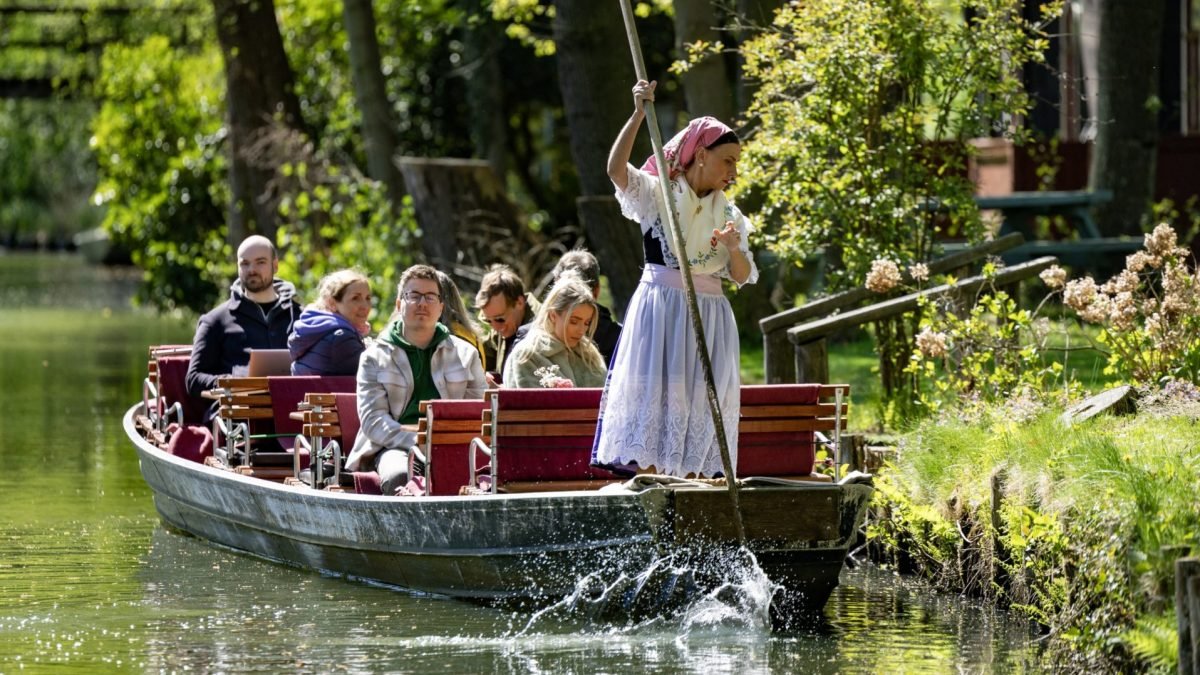
Most people, if they think of it at all, regard the Spree as an urban waterway, the river that runs through the centre of Berlin. But there’s much more to it than that. About 50 miles (80km) south of the capital, it splits into a network of rivers and shallow channels known as the Spreewald, a Unesco Biosphere Reserve that’s Germany’s answer to the Norfolk Broads.
It’s a beautiful area, and ridiculously easy to access, either by adding a couple of days onto a Berlin break, or, for old Berlin hands, by making a special trip. April and May are – perhaps surprisingly – the driest months, although summer also has relatively modest rainfall and reliably warm weather, making the Spreewald a pleasant alternative to scorching southern Europe.
A generation ago, this area was marooned in the East German province of Brandenburg, inaccessible to westerners, and it still feels somewhat off the beaten track for international tourists. The vast majority of visitors – 731,000 of 780,000 in 2025 – are German, with the rest mostly from Poland, Denmark or the Netherlands, and just 2,272 from the UK. Few people speak English. Many of the local people are Sorbians, a West Slavic minority, and road signs are bilingual.

There’s an old-fashioned quality to the tourism experience that’s refreshing. Restaurants close early – pretty much everything is shut by 9pm – and many places still only take cash. While accessible, the waterways are run with a respect for nature, with very few motor-driven craft and nothing allowed on the water after 6pm.
I stayed in the pretty town of Lübbenau, which is probably the best base for the region, not least because it’s easy to get to from Berlin airport – just a 45-minute train ride (or an hour from the city centre).
Like much of the Spreewald, though, Lübbenau feels a million miles away from the capital. The “altstadt” (old town) centres around a triangular marketplace scattered with café tables, and at the harbour area on Damstrasse, chaps in nautical caps stand around waiting for their boat trip groups to arrive.

So far, so Norfolk Broads. The tour boats, though, aren’t gas-guzzling monsters but traditional flat-bottomed punts that have been ferrying visitors around these waterways for a century, with quaint benches and tables decorated with flowers, and blankets to stop anyone catching a chill.
Preferring to travel under my own steam, I hired a kayak and set off to explore. I was given a decent map, and intersections are well labelled, making it all very safe and hard to get lost. Like most people, I headed straight for the nearby village of Lehde, just a short paddle away, an almost impossibly pretty place of wooden footbridges.
It’s home to the popular Spreewald Freiland museum, an open-air collection of rural Sorbian buildings, with displays on the Sorbian people and their predilection for gherkins – an all-pervasive local speciality with an EU Protected Geographical Indication (PGI).
To really experience the beauty of the Spreewald, though, I had to strike out beyond Lehde. The intricate network of small channels offers the chance to seek out peace and nature – beavers and otters are common, with early morning and late afternoon (before the 6pm curfew) the best times for sightings.

I spotted a beaver’s snout poking out of the reeds and was amazed to see a tawny owl hunting in the trees and a stork flying overhead. It’s also not unusual to see kingfishers or sea eagles.
It’s hard to overstate the sheer restfulness of paddling these tranquil and frankly gorgeous waterways.
Birdsong was almost constant, massive alders and poplars towered overhead, vivid yellow butterflies fluttered above the reeds, and the only other sound was the gentle swish of my paddle in the water. My sole source of stress was the process of getting in and out of the kayak – something it’s almost impossible to do with any dignity.
I saw practically nobody between the major centres, and in any case, there were few of those. I was able to paddle as far as the village of Leipe – a huddle of rustic houses set on a river island. Accessing it by the water involves navigating a lock – not difficult, I was assured – but, not wanting to risk it, I chose instead to moor up and saunter in on foot.

The Spreewald isn’t just for paddlers, either; it’s also great for walkers and cyclists, with lots of thoughtfully planned and easily accessible paths, many of which run alongside the water. The ubiquitous wooden bridges even have grooves in them for taking bikes across more easily.
After a day in the kayak, I worked up an appetite by walking the 40 minutes or so from the centre of Lübbenau to the Wotschofska riverside beer garden, which has been serving Spreewald specialities for 100 years.
There were gherkins, of course, but also river fish like perch-pike, and sahne-quark – a creamy cheese served with onions, boiled potatoes and another local favourite: linseed oil, used only for oiling cricket bats and furniture in England. For dessert: delicious, thick, sweet pancakes known as plinsen.
After two days, returning to the city felt like a bit of a wrench. I would have been happy to linger a little longer, paddling, walking, cycling and eating – all before 9pm, of course.
The writer was a guest of the German National Tourist Board and Spreewald Tourism