
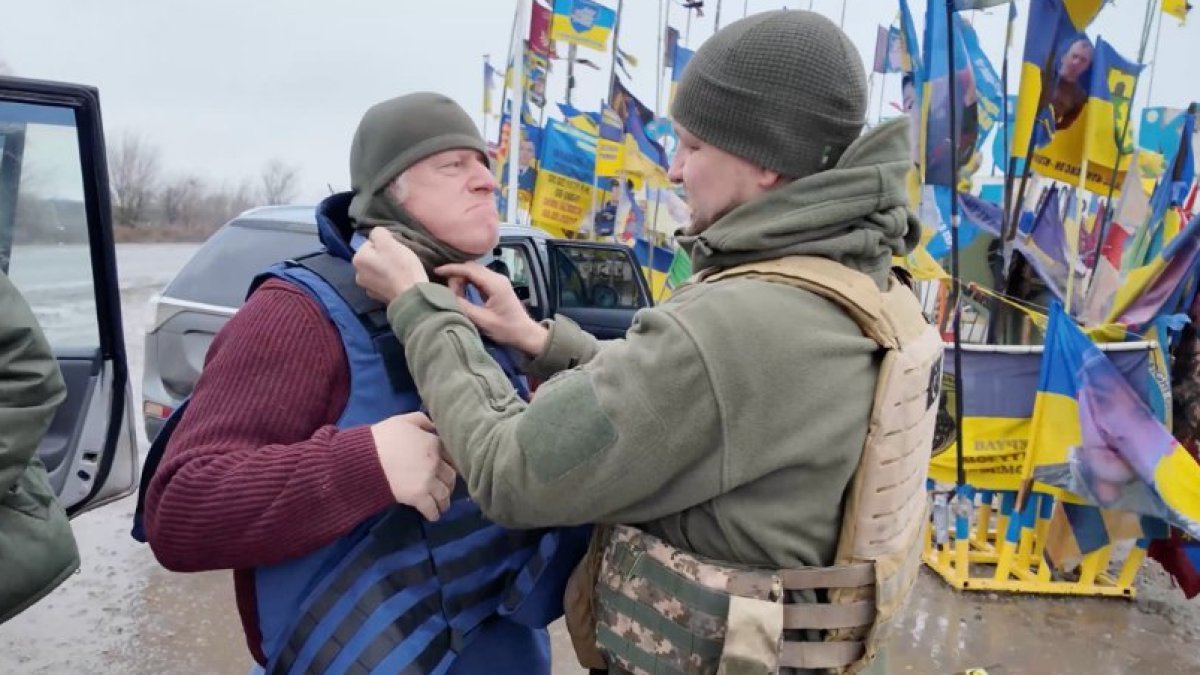

So Boris Johnson now wants to be seen as a hero, putting himself in danger in the interests of highlighting the plight of those living in peril in Ukraine.
Johnson, photographed in a publicity shot donning a flak jacket, has undertaken what we are told is a “deeply unofficial and secret assignment in a dangerous and potentially life-threatening trip” to the frontline of the war. Coming soon to Channel 5.
This is the former Prime Minister who, according to November’s Hallett Inquiry report into the Covid catastrophe, presided over a “toxic and chaotic” culture that led to 23,000 unnecessary deaths in the first wave of the pandemic. That was partly due to his failure to “convey a proper sense of caution” over the virus, as he suggested the British public could just “take it on the chin”.
My father died alone in hospital during that first, tragically delayed lockdown, and I am not impressed by Johnson’s attempt to reinvent himself as a brave war reporter. He is the leader who partied while the rest of us were shut at home, trying to keep each other safe.
His quest for redemption on TV has the working title “Boris Johnson: Into the Kill Zone”. It is a feature-length documentary film based on a 72-hour trip he made to Zaporizhzhia in April. He visited war-damaged villages and a Ukrainian drone base. He met troops from Ukraine’s 65 Brigade. At one point, he found himself sheltering in a high-rise flat during a Russian missile strike.
I am sure the film will have value in keeping this too-easily-forgotten conflict in the public eye. It has been made by two respected production companies and Johnson’s access was secured in collaboration with Richard Pendlebury of the Daily Mail, a real and eminent foreign correspondent who accompanied the former politician in Ukraine.
What irks me is that Boris gets to position himself as the star of the show. He is in no way a reliable voice when it comes to world affairs, or indeed anything else.
His prime experience as a foreign correspondent was a stint working in Brussels for The Daily Telegraph as “European Commission Correspondent”. Johnson’s fanciful reporting – conjuring up stories about over-regulation of condom sizes and the shapes of bananas – was pivotal in shaping the Eurosceptic movement that led to Brexit a generation later. “He was the paramount of exaggeration and distortion and lies,” complained Willy Hélin, the European Commission’s long-serving spokesman.
Somehow, Boris would go on to become Foreign Secretary but he was famously distrusted by his own civil servants. He was said to have “the attention span of a gnat”. The BBC claimed that some in the intelligence services had concerns over his ability to keep information confidential. His false depiction of Nazanin Zaghari-Ratcliffe, while she was being held in an Iranian jail, was another dangerous blunder when he was the Foreign Secretary.
The list of Johnson’s lies is never-ending. From misleading MPs over Partygate, to advising the Queen to unlawfully prorogue parliament in 2019, to the £350m for the NHS whopper during the Vote Leave campaign, all the way back to making up a quote from his godfather for a front-page story in The Times, for which he was sacked at the start of his career in journalism. Can we now trust his reportage?
While Johnson’s backing for Ukraine has been unswerving since Russia’s invasion in 2022, when he was Prime Minister, his successors in Downing Street have maintained the UK’s position as a staunch ally of Kyiv. So it would be wrong for him to use this TV opportunity as a soapbox for attacking political adversaries. In a recent article about his Zaporizhzhia expedition, he did that, saying: “We are risibly failing to live up to our pledges.”
Ukrainians will welcome his efforts in raising the profile of their struggle. But as a prime architect of Brexit, Johnson weakened Europe’s unity ahead of the gravest threat to its security in nearly a century. The former Prime Minister is also part of a governing class responsible for the dilapidated state of the UK Armed Forces. And his supposed former pal Donald Trump, whose election he greeted as a “big win for the world”, has disgracefully undermined Ukraine’s leader Volodymyr Zelensky.
Channel 5 thinks it has a coup. One of the film’s producers predicted that “this will be the most talked about doc of the year and make worldwide headlines as it sells internationally”. What a shame that TV needs the celebrity factor to give this conflict coverage, and even more of a shame that the celebrity is Boris. He is hardly the first to go to Ukraine. Sean Penn, Angelina Jolie, Liev Schreiber and Bono have all visited since the invasion. Prince Harry was there for the third time in April.
Since departing Downing Street in disgrace, he has been repeatedly linked with jobs in TV. A leaked cache of his private emails included a reality show pitch to streaming platforms. There was talk of a fly-on-the-wall show with the Johnson family, in the style of Meet the Rees-Moggs. Three years ago, Johnson announced in a video that he was “shortly going to be joining” GB News as a presenter. “I’m going to be giving this remarkable new TV channel my unvarnished views on everything from Russia, China, the war in Ukraine,” he promised. The series never appeared.
Now Boris wants to be a TV war reporter, but there is only one assignment for which he is obviously qualified: heading into the jungle like his father Stanley, his inept former health secretary Matt Hancock, and so many other “celebrities” hoping to rescue their sullied reputations.