
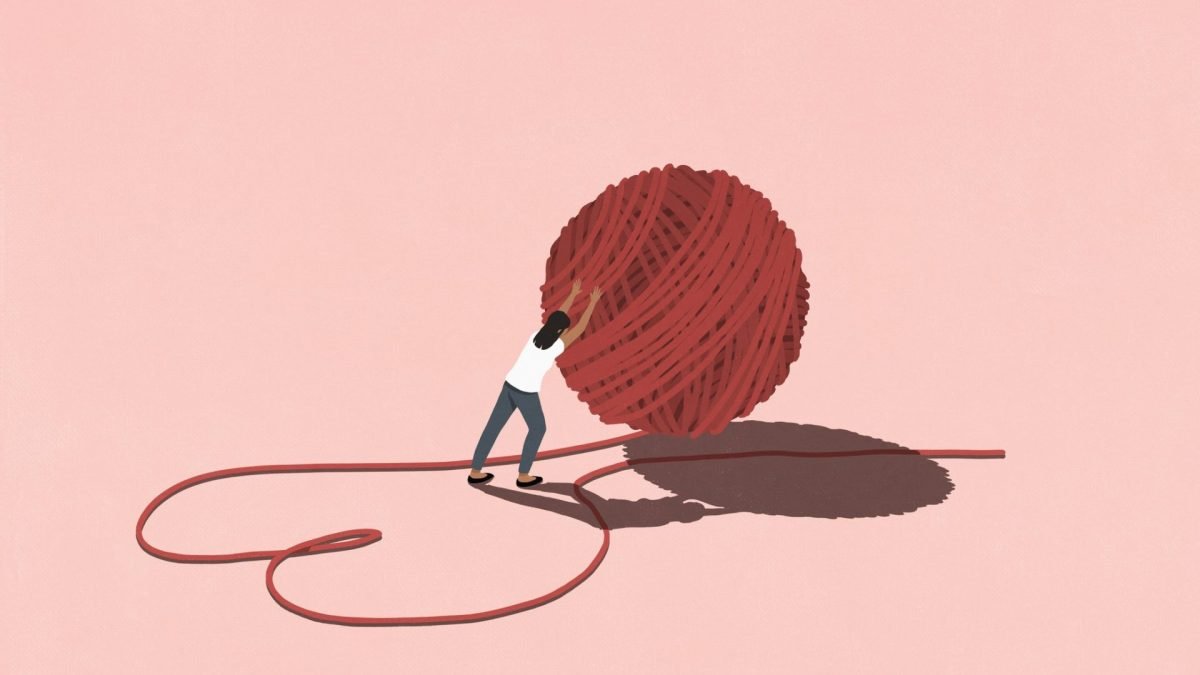
What do Tom Holland, Winston Churchill and King Charles all have in common? I can’t answer that completely comprehensively, but I can tell you that they have all unlocked one of the most important skills in stress management: emotional regulation and reaching a flow state. They have all discovered the benefits of behavioural activation.
After Holland received a crocheted spiderweb can holder this week from Tom Daley, he shared online that he loves to crochet as a way of turning his brain off after a stressful day. Churchill was a keen bricklayer with a target of laying 200 a day, and he used it as a way to escape the pressures of his political work and to keep his mind distracted when he was feeling down. And King Charles has stated that painting transports him into another dimension, saying it is one of the most relaxing and therapeutic exercises that he knows.
Research has shown that humans have up to 70,000 thoughts per day, with approximately 75 per cent being negative and up to 95 per cent being about the same repetitive thing. With these statistics, it is not surprising then that we might want to have some healthy escapism, or we put ourselves at risk of those thoughts negatively impacting our mental health. Given that our brains are good at processing multiple things at high speed, you might conclude that it is our brains that could also solve our stress for us; if only we just think hard enough. Wrong. Although there is a role for this with strategies like problem-solving and decision-making, there are some things that we cannot think our way out of. It is in these scenarios that we must rely on action to get us out of the stressed zone.
And there is science behind this; it is called behavioural activation, which means taking action as the first step. Normally, when we feel stressed or low, we stop doing the things we usually do, and this creates less to feel good about. We wait to feel a bit better before resuming our normal routine, but instead we just continue feeling the same; creating a negative loop that, in turn, makes us feel more low and more stressed. Instead of waiting to feel less stressed before we do something, we have to do something in order to feel less stressed. In this way, action comes first and our emotional state second.
And this is where activities using your hands, like painting, crocheting, or bricklaying, really work. They have an extra layer of benefit in that they allow us to get into a “flow state” where those repetitive, ruminating, negative thoughts are crowded out, and we are purely and simply in the present moment. A flow state is one in which you can perform and feel at your best, and which, when you come out of it, allows you to feel much less stressed, with the release of dopamine and serotonin, and for you to approach your problems in a more resourceful state.
Here are some “hands-on” activities and their proven scientific benefits, so why not try one of them this weekend?

DIY
Research has shown that doing DIY and woodwork is associated with higher life satisfaction, as well as reducing stress levels and allowing greater feelings of progress and satisfaction.
Pottery
A study in 2023 showed that working with clay for just 45 minutes significantly reduces cortisol levels, our stress hormone.
Needlecraft
An international research study showed that people who crocheted reported a significantly higher level of calmness and happiness, as well as evidence that the repetitive movement of needlecraft can act as a form of meditation.
Painting
Research has shown that painting can help individuals process difficult emotions as well as reduce their stress hormone levels.
Gardening
A meta-analysis of 40 research studies showed that regular gardening reduces stress and fatigue, and can result in a significant improvement of mental wellbeing and quality of life, as well as improved life satisfaction and an immediate reduction in anxiety.
So, the evidence is there, but if you want to start introducing a bit more behavioural activation into your day, you have to remember a couple of things to make sure it is a success, because there is some nuance to this. You need to schedule them in so that you don’t simply allow them to fall out of our diaries. You need to commit to them and let go of your preconceived ideas, and just have a sense of adventure. And you need to choose an activity that you normally enjoy or a task that you know gives you pleasure. We all know how hard it is to push ourselves to do something if we are feeling stressed, so use a little sprinkle of joy to help you take that first step to making hands-on action your go-to strategy.