
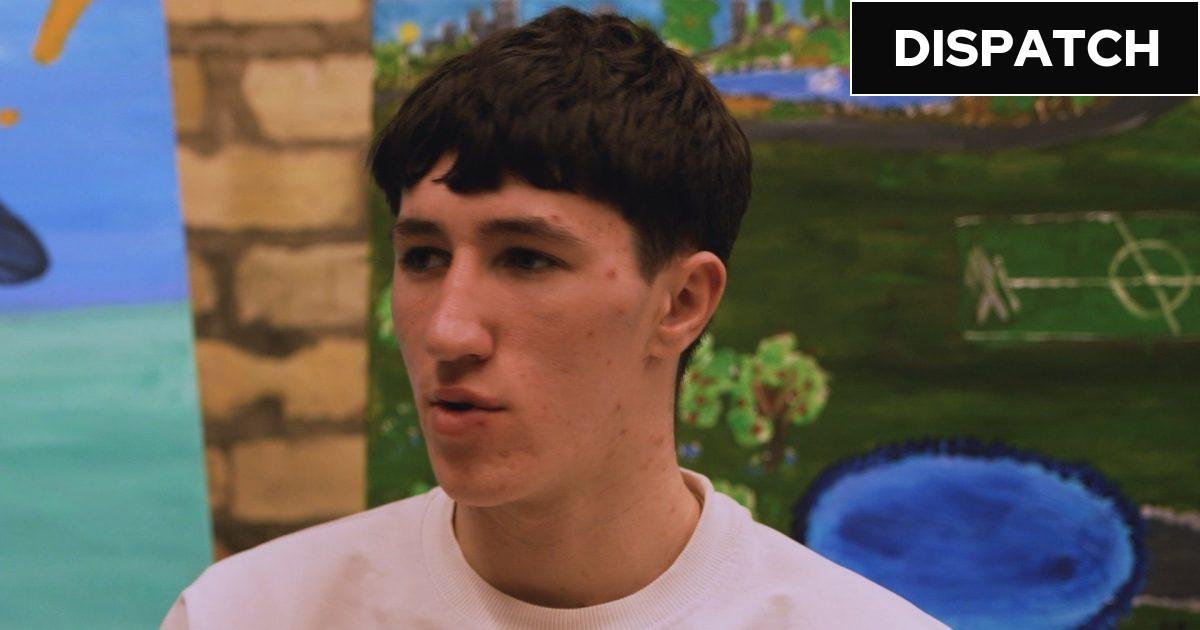
KYIV – Rostislav Lavrov was 16 and living with his mother and grandmother in the village of Radensk in Ukraine’s eastern Kherson region when Russia’s full-scale invasion began on 24 February 2022.
“We didn’t leave because, by lunchtime, Russian soldiers came to our village,” Lavrov, now 20, told The i Paper.
A week after Russian troops occupied his village, Lavrov said his grandmother passed away due to health issues, while his mother was taken away to a mental health clinic. Speaking to The i Paper in Kyiv, Lavrov said he was then forced to live under Russian occupation alone for about four months, carrying out garden work for neighbours to get a bit of money for essentials like food.
But one evening, a group of armed soldiers showed up at his home. “It was already dark, I heard someone knocking on the gate,” he said. “There were five soldiers and the head of the village, that is, a collaborator.”
Lavrov said the troops approached him with an offer to leave his village and go to study at a college that followed the Russian curriculum. He said he did not want to leave his home but they told him: “Either you go, or we will take you to some orphanage or elsewhere.”
Two days later, armed troops in balaclavas came back to Lavrov’s house and pressured him into moving to a dormitory in Russian-occupied Kherson. “Then, after a month, the director came with two men, and they said: ‘Tomorrow you go to rest in Crimea for two weeks.’”
He was taken to a bus along with other Ukrainian children to travel to a camp in Crimea, a peninsula in southern Ukraine that was annexed by Russia in 2014 after a sham referendum. There he experienced the efforts Vladimir Putin’s Russia has gone through to indoctrinate young Ukrainian children.
Russia has engaged in the deportation, re-education, militarisation and coerced fostering of children from Ukraine since at least 2014. Since 2022, children have been taken to over 200 sites across occupied territories and eastern Russia – 19 of them located in Crimea, according to research by the Yale Humanitarian Research Lab (HRL).

HRL found children at the facilities – which range from camps and cadet schools to orphanages and sanatoriums – underwent pro-Russian re-education and, in many cases, were placed in programmes of forced militarisation, including combat and paratrooper training.
According to the Ukrainian government, as of March 2023, at least 19,546 children had been abducted by Russia, while the HRL last year placed the figure at closer to 35,000.
Daria Herasymchuk, the Commissioner for Children’s Rights and Rehabilitation in Ukraine, estimates that the number is now between 200,000 and 300,000, while her Russian counterpart, Maria Lvova-Belova, who is wanted by the International Criminal Court over allegations of unlawful deportation and transportation of children, claimed in 2023 that over 700,000 Ukrainian children had been “relocated” to Russia.
Rescued children have detailed first-hand accounts of torture, intimidation and cultural erasure, and said they were told they would be separated from their parents if they refused Russian citizenship.
Reflecting on his own experience, Lavrov told The i Paper that the first two weeks were normal, but that by the end of the two-week period, the children were told they needed to stay for a further two weeks due to heavy shelling in Kherson.
“Two weeks passed, and they started to treat us badly, their propaganda started,” he said. “They didn’t like that we spoke Ukrainian. They said, ‘If you come to Russia, you have to speak Russian, respect it.’”
The children were forced to sing the Russian national anthem every morning, and were punished if they refused to do so. “I didn’t want to sing and to stand there at all. I was punished, they put me in solitary confinement,” he said.
Lavrov said he spent about two weeks in solitary confinement in total for disobeying orders. “There was a small room and you sat there without a phone, without anything. Just their book with propaganda, and you either read it or just stare.”
After his release from solitary, Lavrov began contemplating his escape from the camp, but feared he would be captured by Russian troops if he ran away.
“We planned [to run away], but if we even run away, it doesn’t matter. In an hour or two, they will see that we are gone and they will run after us quickly,” he said.
Lavrov spent a year in the camp and a military college in Crimea, and was ultimately rescued during a clandestine mission orchestrated by Save Ukraine, a charity supporting vulnerable Ukrainian children and their families. The i Paper was asked not to disclose specific details of the recovery in order to avoid exposing the tactics to Russian forces, which could impact future rescue attempts.
Lavrov said he shares his story so the “whole world can see how Russians are abusing Ukrainian children, how they want to make Russian children out of Ukrainian children”.
“When I was there, I understood that they were making Russians from Ukrainian children, and that these children would then fight against their own state.”
The remarks were echoed by Mykola Kuleba, Save Ukraine’s chief executive, who told The i Paper: “They brainwash kids every day and turn them into Russian soldiers.

“We are rescuing lots of kids from [the] Russian army, from conscription, because Russia forcibly conscripts them and then it could be really hard to take them from the Russian army,” he added. “They can just die for nothing.”
Kuleba said over 1,000 children have been rescued to date by Save Ukraine, many of whom then gave the charity information about other abducted children, facilitating further rescues. He said those involved in the rescues could be arrested “or just killed” if they were caught, with Moscow fearing children who escape could be able to reveal information about Russia’s crimes.
A report by Save Ukraine, the War Child charity and Human Security Centre think-tank found that 55 per cent of Ukrainian children returned from Russia or Russian-occupied territories have been subject to indoctrination.
The report, carried out via interviews with 200 children, also found that 41 per cent experienced militarisation through school-based training or membership in organisations backing the Russian military.

“There isn’t really another way of saying it. They’ve been stolen,” War Child’s chief executive Helen Pattinson told The i Paper as she reflected on cases like Lavrov’s. “They’re being made to dress up in Russian clothes, their passports are taken away, their names are changed. You are really just stripping a child of everything that is personal to them, which is completely inhumane, not least separating children from their families.”
When Lavrov finally returned to unoccupied Ukraine, he told The i Paper he did not have any documents or clothes. “Save Ukraine helped me get documents. A psychologist talked to me because I came here and I was not very talkative,” he said.
He currently works part-time in construction and spends his spare time pursuing his dream of becoming a photographer.
In a message to those who remain in Russian hands, Lavrov said: “The most important thing is not to be afraid.”
“They like to say that Ukraine will not exist anymore,” he added. “You can’t believe it.”