
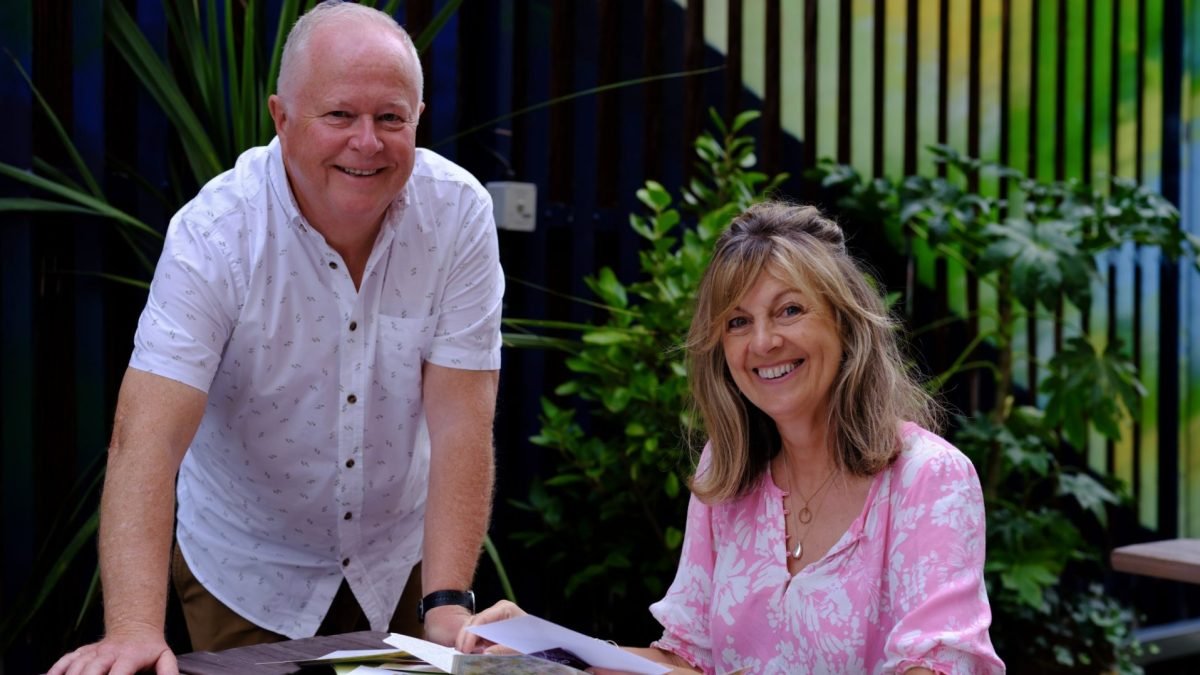
Alison Hitchcock and Brian Greenley had only been friends for six months when he was diagnosed with stage three bowel cancer. As such, when they met for a catch up in June 2010, Brian didn’t intend to share his news.
“She was really just an acquaintance rather than a close friend,” he tells me, the pair having first met on holiday the year before. “But I blurted it out and told her that I had cancer. Two weeks later, to my surprise, on the doormat was a handwritten letter from Alison.”
“When Brian first told me he had cancer, I just felt really awkward and helpless and I didn’t know what to say, because I didn’t really know him that well,” Alison explains. “I didn’t really want to get too involved, but I felt like I had to do something that was in some way helpful.”
And so, she put pen to paper. It ended up being the first of more than 100 letters that Alison sent to Brian over the two years that he was going through treatment – letters that proved to be a vital source of companionship.
“As Brian and I got to know each other better, he started to say that one of the unexpected side effects of cancer is that he had times when he felt lonely,” she says. “Brian has such a big social circle that of all people, I never thought that he would say that.”
“Alison’s letters made me laugh, they cheered me up, and they did the trick of distracting me,” Brian says. “I used to take them to my chemotherapy sessions and read them at a time when I couldn’t really concentrate on a newspaper or a book or much else. Those letters were just perfect.”
In 2013, Brian got his first all clear and the letters stopped. Then, they decided to get in touch with BBC Radio 4’s The Listening Project – a programme which called for members of the public to volunteer to have a conversation with someone close to them recorded by their local radio station. In the 2016 Christmas Day special, it broadcasted the story of how their friendship blossomed through the letters.

Soon after it aired, a neighbour told Alison that he had been inspired to send letters to his own friend in Australia who had recently been diagnosed. But two weeks later, the neighbour returned to Alison’s door. “He came back to me and said, ‘ I don’t know what to write. What do you write to someone who’s got cancer?’”.
In response, Alison started running online writing workshops to guide people through penning their first letter – an initiative she called From Me To You. “At first it was just to say, ‘if you’ve got someone in your life who has cancer, don’t turn your back on them because you don’t know what to say. Just send them a card or a letter to let them know that you’re thinking of them’”.
But it soon became much more than that: “Increasingly, people were saying [they would] like to write more letters and asked us who they could send them to.”
Inspired, Alison decided to set up From Me to You as a charity with an organised programme in which people write letters without knowing who the recipient will be. It now has thousands of volunteer writers around the world, over 50 partner hospitals and cancer centres and hundreds of people who receive them at home every month. In 2025 alone, the charity sent more than 17,000 letters from strangers to people going through cancer treatment in hospital or at home.
54-year-old Anne Bailey from Belfast was one such volunteer letter-writer. Then, in October 2022, she was diagnosed with a rare incurable metastatic Neuroendocrine Cancer and concomitant carcinoid syndrome and suddenly found herself on the other side of the table.
“I was really hesitant about asking for a letter because it seemed like a big deal, expecting someone I had never met to write to me,” she says. “But it made such a difference. When you have an illness that won’t go away, it changes the way that you think about yourself and the way that you think about your place in the world. I was a teacher, I was head of a department, I had a busy life – and then suddenly none of that was true.”
The letters offered comfort throughout not only her treatment, but the tragic losses that followed, including the sudden death of her husband two years after her diagnosis and the passing of her father the day before she went in for life-extending surgery.
“Throughout all of this, From Me To You has been one of the loveliest and most encouraging aspects of life – and a genuine reminder of the power of hope and kindness in hard situations,” she says.

Handling physical letters brings logistical complications – every note is read by one of 10 volunteers to check if the contents are appropriate before being posted onwards – but Brian emphasises that the physicality of a letter is crucial for patients. “I would sometimes save the letters until I went to treatment. With an email, you open it straight away. Do you ever revisit and re-read an email? Unlikely. Do you ever go back and re-read a text? Not likely. With a letter, you’ve got something that you can touch and feel.”
And in the age of convenience, Brian adds that the relative inconvenience of writing a letter brings a personal touch. “Over time, emails have gotten shorter. Texts have become shorter. Even words and texts have become abbreviated. But a letter is still written in long hand, and the words are fully formed. I think that makes it more meaningful, too.”
While the charity is now best known for its letter donations, it still runs regular workshops online for those wanting to get involved in writing – and partner organisations and volunteers have begun to host in-person sessions in community hubs across the country, too.
Helen* and her family spent their Easter Monday at a drop-in letter writing session at St Barts Hospital in East London. During the session, her young daughter tells me that she wrote a funny story about their family dog in her letter: he was recently on a bus and scooted forward a few inches every time the driver braked, until he was halfway down the aisle and still none the wiser. We laugh at her animated retelling of the story, which she’s illustrated on paper using the coloured pens neatly arranged on the table. “If I was feeling rubbish, I think that would make me smile,” her mum responds.
For this family, attending the session was also connected to an important part of their own recent history. Their teenage son, who is also at the workshop, went through treatment for leukaemia two years ago; an experience that affected the family deeply. “We wanted this to be a cathartic process,” Helen tells me. “I want him to know that he doesn’t have to bury it or carry that around with him – it’s part of his story.”
It’s a catharsis that others have also found through writing, according to Brian. “The feedback we get from writers is that they got something out of it for themselves. Spending time alone writing a letter was meditative for them, or gave them time to distract themselves from where they were in that moment of writing.”

Anne has continued to write letters for others – and considers them even more important now. “I have found it has really enhanced my daily life and made me more grateful, because if something lovely happens, I think, ‘oh, that’s going to go in a letter’,” she smiles. “It definitely has made me more observant of the lovely things that can happen on an ordinary day.”
For those keen to write but feeling intimated by the process, Alison and Anne both recommended attending one of the charity’s writing workshops – and caution against overthinking.
“The loveliest letters are the ones that observe the little details, just the ordinary things in life,” says Anne, sharing that one letter that stood out for her arrived when she was bedridden, from a lady in Cornwall who described the smell and taste of the salty sea air.
“I tried to put sensory descriptions into [my letters now],” she adds, “because you don’t know if the person is in a hospital bed, or if they’re in bed at home, or if they’re trying to get on with life as much as they can. So reminding people of the beauty of ordinary things is important.”
And she emphasises how the impact of these letters is less to do with the sophistication of its contents, and more with the feeling of connection that comes from a selfless gesture.
“These acts of kindness really felt like they were bringing light into dark situations,” she says. “It reminds you that the world is a lovely place with wonderful humans in it who are doing things like this.
“The people who wrote me letters will never hear from me, they’ll never hear that this really mattered to me, but they do it anyway – and that is very special.”
*Surnames withheld for privacy
Visit frommetoyouletters.co.uk