
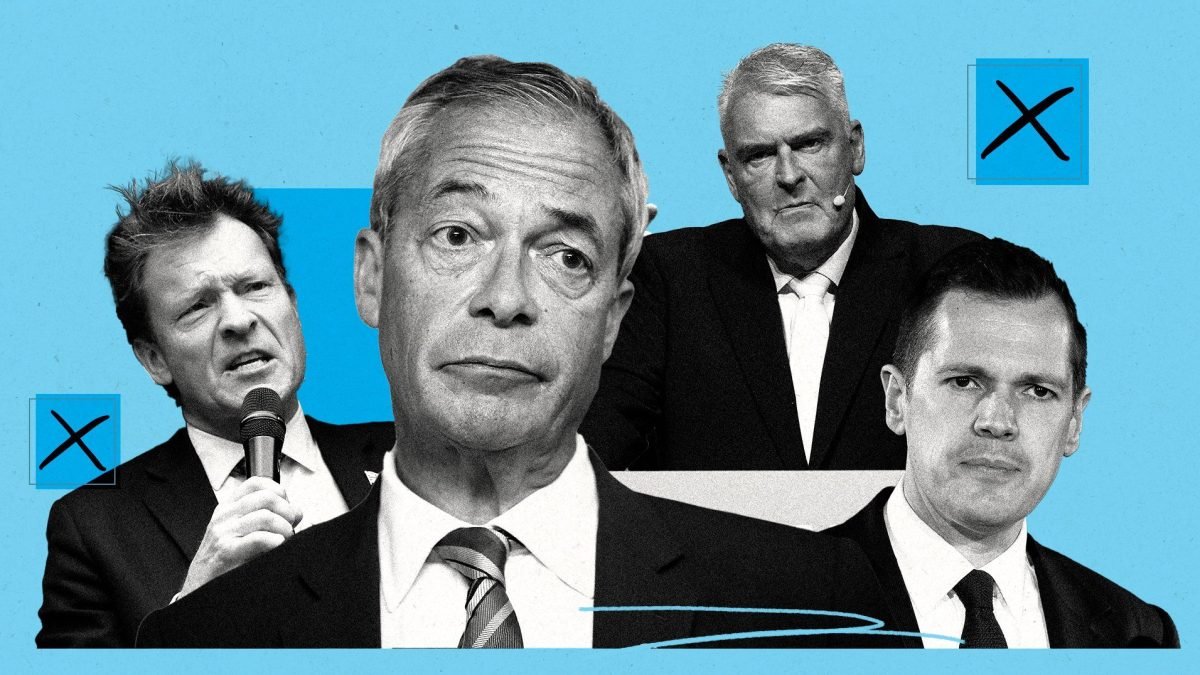

As Reform UK revels in its success in last week’s local elections – winning 1,450 council seats – the idea of prime minister Nigel Farage no longer looks like a pipe dream for the Clacton MP.
In response to Friday’s results Farage said this is “a truly historic shift in British politics,” and that these results would not be a “one-off”.
There is no doubt that the party has capitalised on public frustration over immigration, living standards and distrust in Westminster – and has gone from a fringe movement to a serious force in British politics. But, can Reform UK keep growing – or has it peaked?
Michael Crick, Jonn Elledge and Zoë Grünewald offer their perspectives.
On Friday night, as a turquoise tide threatened to drown old parties and liberal values alike, the veteran pollster Peter Kellner said something reassuring: “Nigel Reform should be privately worried.”
“If there were no polls, and there had been no elections last year, this year’s figure would be astonishing,” he wrote on his Substack about Reform’s percentage vote share. “But we do have the record of recent polls and elections, and it seems clear that Reform has peaked.”
This was, so far as it goes, comforting. It does not go very far. Reform still “won” the local elections, taking councils in red and blue Britain alike. It still leads the national polls, albeit less convincingly than it did last autumn (on roughly 25 per cent, down from 31 per cent).
Sure, the Government’s travails may come less from Labour-Reform switchers than from losing votes to the Greens – but under a first-past-the-post electoral system, that is enough to make prime minister Nigel Farage a terrifyingly plausible outcome. Perhaps tactical voting could stop it. But would you bet your NHS on it?
If there is a way out, it seems extremely unlikely to come from the Conservatives, who are even now consoling themselves that their worst results ever – and the end of centuries as the main party of the British right – were actually good because they nearly won back control of Wandsworth. Nor does it seem likely to come from a Labour Party currently plotting to change leaders in roughly the way the Three Stooges come up with a plan to get through a door.
As to the media, even if large chunks of it were not licking its lips in anticipation, it’s no longer clear it has the power to shift the narrative. None of the financial scandals – the £5m from a crypto billionaire before Farage’s return to British politics; the endless questions about Richard Tice’s tax affairs – have cut through. Nor has the extensive coverage of Farage’s schoolboy racism. The voters, it seems, don’t care.
There is, though, one threat left that may not be so easily batted away. Reform’s true nemesis may yet turn out to be Reform.
Taking over an English council in 2026 is not, after all, a fun thing to do. Nothing works, everyone is angry and it’s harder to sort the bins than you might think. Worst of all, it turns out that there isn’t a huge pile of money being wasted on rainbow balloons and wokery: it disappears straight into the social care system.
Consider events in England’s largest county council, Kent, where Reform stormed to power last May. Five months later, a video surfaced of a budget meeting on Zoom, in which leader Linden Kemkaran swore at unruly fellow Reform colleagues and told them to “suck it up”. They were, she said, “a bunch of people who unfortunately put their own self-interest before duty and before service”; five were suspended from the party within days.
Such scenes are all but certain to be repeated, with a cast list that makes the Kent lot look positively professional by comparison.
Councillors elected last week included Wakefield’s “Lion of Judah”, who promised to bring “holy fire” down on anyone who gets in his way; an MSP who’s expressed support for Tommy Robinson and deporting all British Muslims; and a guy in Sunderland who, days after being elected, is under investigation for racism and facing suspension from Reform after reportedly saying in 2024 that Nigerians should be “melt[ed] down” to “fill in the pot holes” in a now-deleted social media post.
It’s not all bad news. The Senedd candidate of whom a photo emerged doing what Farage described as a Basil Fawlty impression was deselected; the potential Westminster councillor who fat-shamed nurses and said he wanted to see the NHS “torn down to the ground” lost. But more power means more attention, and it is not clear that those who now hold it will provide a good advert for Reform in office. There’s a very real chance Reform’s success could be self-limiting.
But then again – what if it isn’t? In 2006, the Guardian’s Nick Cohen gleefully noted that Stoke-on-Trent’s first BNP councillor had spoken only twice during two years in office; once was an interruption to ask what “abstain” meant. I’ve consoled myself with that for years, and only just thought to look up what happened next: Stoke elected yet more BNP councillors the following year.
Reform is not the BNP; and perhaps this time will be different. But quite possibly it won’t. And if Nigel Farage does make it to Downing Street, dragging this clown parade in his wake, the fact his popularity peaked in 2025 will be of no comfort whatsoever.