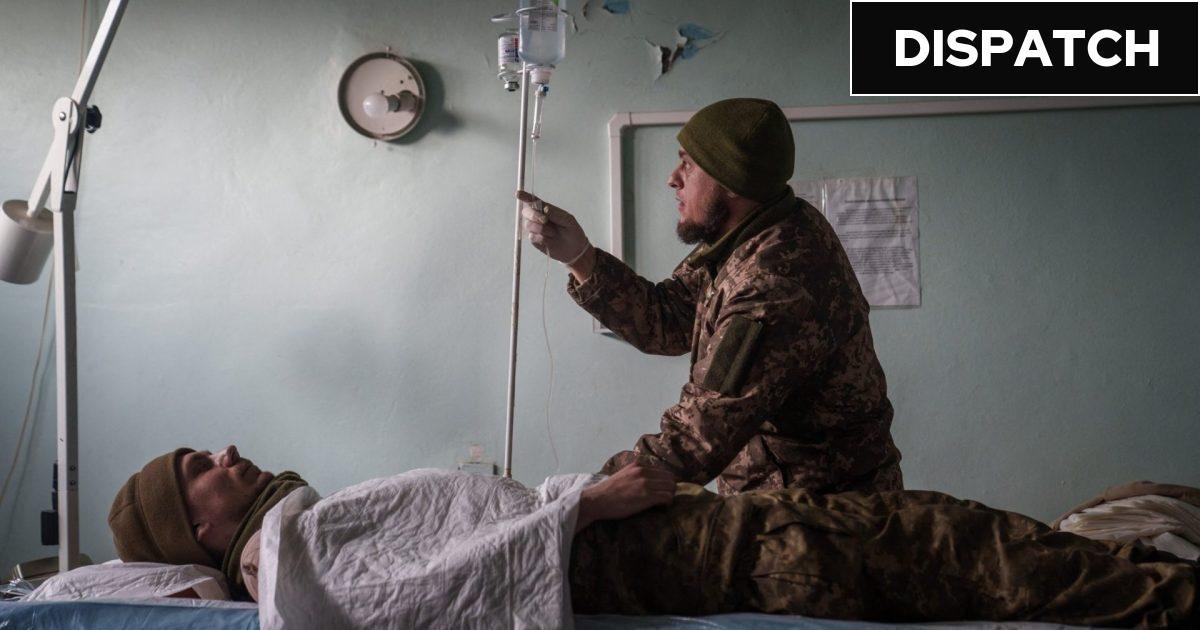
KYIV – In the waiting area of the Superhumans Center in the Ukrainian city of Lviv, two patients, one in a wheelchair with an arm and two legs amputated, are playing table tennis as others watch on. A massive screen is showing relaxing scenes of nature, with an accompanying soothing soundtrack playing in the background.
Danylo Turkevych, the head of the surgery department – who started his medical practice right as the full-scale Russian invasion began – said the challenge during the war of achieving fast and effective medical care for those on the front lines has been immense.
“Evacuation of patients would take two to three weeks, sometimes even months, to get them from Dnipro, Donetsk and Kharkiv to Lviv,” he says of the early days of the conflict, when he worked at a state hospital.
However, in many ways the challenges have only grown since then.
Wartime conditions in Ukraine have created an ideal environment for serious antibiotic-resistant infections to develop. These so-called “superbugs”, which are resistant to many, if not all, commonly used antibiotics, can be deadly and spread far.
The most concerning is Klebsiella pneumoniae, a bacteria estimated to be responsible for over 100,000 deaths a year.
Danylo Turkevych has been working as a doctor in Ukraine since the Russian full-scale invasion began (Photo: Finbarr Toesland)
When it comes to Ukraine, a combination of overcrowded hospital wards, weak infection control and micro-dosing of antibiotics to prolong supplies are resulting in the spread of superbugs.
Turkevych says the situation with AMR is going from bad to worse. “I may be a fatalist but I think we are already in the post-antibiotic era, because it’s not only a Ukrainian problem, it’s a problem in the whole world,” he said.
Rising death toll
According to a report in The Lancet, 1.14 million deaths globally in 2021 were directly attributed to antimicrobial resistance (AMR). From 2025 to 2050, researchers forecast that more than 39 million deaths will be linked to AMR.
Meanwhile, as Ukrainian patients with war-related wounds have been evacuated to hospitals across Europe, difficult-to-treat infections have been reported in Germany, Denmark and the Netherlands.
A study by the University of Helsinki and HUS Helsinki University Hospital found that of the eight per cent of Ukrainian refugees who had been hospitalised for war-related injuries, close to 80 per cent carried multi-drug resistant (MDR) bacteria.
A wounded Ukrainian soldier. War-related injuries are raising fears over antibiotic-resistant infections (Photo: Scott Olson/Getty)
“We strongly recommend targeted MDR screening and strict contact precautions for patients hospitalised in conflict zones,” it said.
Richard Sullivan, the co-director of the Centre for Conflict & Health Research at Kings College London, said that European programmes tend to be focused on high-threat infectious diseases such as dengue fever and rabies, leaving gaps in how antimicrobial resistance is tracked.
He told The i Paper that while some hospitals have been good at swabbing and looking for resistant infections, others have not been so good. “The problem is there’s so many other things going on that until we have a massive crisis, it’s very hard to do something about this.”
“We are living in a world where there is no money. The idea that we’re going to coordinate and do better surveillance is lovely on paper. In reality, unless there is government‑mandated reporting and analysis, it doesn’t get done,” Sullivan said.
A worrying technique
When antibiotic resistance expert Olena Moshynets, a microbiologist at The Institute of Molecular Biology and Genetics in Kyiv, started her research on AMR resistance a decade ago, there were already multiple-drug resistant bacteria in the country.
“Ukraine was more isolated, a lot of people travelled abroad, but they were healthy,” she said. Now, with Ukrainian wounded being sent for treatment abroad, that is often not the case.
Olena Moshynets says the process of how some wounds are treated has added to the problem in Ukraine (Photo: Finbarr Toesland)
Meanwhile, a technique called negative pressure wound therapy, which is a technique using a suction pump, tubing, and a dressing, creates further problems.
“It was a really good way to close soft tissue,” said Turkevych. “But people tend to overuse it and you then have a high risk of growing bacteria deep in the soft tissue of the bone. Due to that, we had a huge number of delayed amputations.”
In February, Turkevych operated on a patient with an infection of the tibia bone. “In this scar tissue, there was dense fabric from his trousers and metal particles from the explosion, we had to cut all that off, clean the wound and then do an operation to close the defect,” he said.
The patient was able to keep his limb, but others are not so fortunate, and amputation often becomes the only way to stop the spread of infection, Turkevych said.
“If you get multi-drug-resistant bacteria and we are able to treat it, sometimes amputation is the only possible way to salvage the person,” he added. “If it’s not amputated it will spread.”
In some patients, even amputation is not enough to stop the antibiotic-resistant infections proliferating.
“It won’t kill you but there are studies that show the patient will produce that bacteria in two or three years after the initial surgery,” Turkevych said. “You’re basically becoming a biological weapon.”
Wounded Ukrainian soldiers awaiting evacuation for treatment in Donetsk, Ukraine (Photo: Kostiantyn Liberov/Libkos/Getty)
A country on the edge
Prevention is better than a cure, but a severe lack of funds and essential medication is making it almost impossible in Ukraine to address the root causes.
The first step is to bring back nurses, says Moshynets. “We may have one nurse for each 30 beds. It’s impossible to keep on top of infection prevention and control, it doesn’t matter how great the nurse is.”
She added that while the official position of Ukraine’s health ministry is that they have funds to cover all needed medication, the reality on the ground is very different.
“My colleagues, just normal doctors, tell me their salaries have been reduced and they don’t have normal antibiotics, even in Kyiv. That’s a big problem when it comes to AMR,” she said.
The State Institution Center of Public Health of the Ministry of Health of Ukraine, which is responsible for infection prevention and control as well as antimicrobial resistance and related data, did not reply to a request for comment.
This acute shortage makes healthcare outcomes far worse for patients. Moshynets recalls a recent case where a patient had a liver abscess as a result of a case of Klebsiella. After their first unsuccessful treatment, the clinician reached out to Moshynets for advice.
Concerns are growing over a severe lack of funds and essential medication in Ukraine (Photo: Kostiantyn Liberov/Libkos/Getty)
“The strain was already resistant to the first antibiotic that was used,” she says. But when Moshynets when back to ask why this was given to the patient, she was shocked by the doctor’s reply: “He said that was the only antibiotic we had.”
For Sullivan, his fear is that infections originating from the battlefields of Ukraine could soon spread across the rest of Europe.
“Modern battlefields like Ukraine create the perfect storm for AMR,” he said. “Massive environmental toxicity, ordnance and destroyed infrastructure, contaminated wounds, long evacuation pathways as well as mobility from hospital to hospital create the ideal conditions for AMR, which is no respecter of borders.”
Ultimately, Sullivan said, monitoring closely and having a better understanding of where and how to mitigate the threats is “crucial for stopping the wider spread of AMR”.
Shorts – Quick stories
Pornhub to become accessible again for some UK users
Pornhub’s parent company Aylo said Apple users who had confirmed their age with the company’s updated iOS would be allowed back on the site.
Caption: The Pornhub logo is displayed on a smartphone screen with a multitude of pornographic website logos in the background. The pornographic website announces that it blocks its services to new users starting in February 2026 in response to the age verification requirements imposed by the Online Safety Act (OSA), in Creteil, France, on January 28, 2026. (Photo by Samuel Boivin/NurPhoto via Getty Images) Photographer: NurPhoto Provider: NurPhoto via Getty Images Source: NurPhoto Copyright: Samuel Boivin/NurPhoto
What’s the latest?
In February, Pornhub limited access for most UK users unless they had previously verified their age.
Parent company Aylo said Online Safety Act age verification rules had not been fairly applied and refused to join in a flawed system.
Now, it said Apple users who had confirmed their age with the latest iOS update would be allowed on.
Aylo argues device-level checks are the best way to stop young people accessing explicit content.
LIFESTYLE
4 min read
Has the Online Safety Act worked?
Major platforms have been affected by the landmark Online Safety Act, with Pornhub seeing a 75 per cent drop in UK users since the introduction of more robust age checks.
However, critics have questioned whether people are simply using VPNs instead, allowing them to evade age checks by masking their IP addresses.
Caption: BRISTOL, UNITED KINGDOM – FEBRUARY 07: In this photo illustration, a age-restriction warning screen for the adult website Pornhub is displayed on a iPhone digital screen, on February 7, 2026 in Bristol, England. Last year UK communications regulator Ofcom issued guidance under the Online Safety Act that required websites with pornographic material to introduce “robust” age-verification measures for UK users by July 2025. Aylo, the parent company of the website Pornhub, has criticised such age-verification measures, saying they simply force users to darker corners of the web that do not require age checks. (Photo by Anna Barclay/Getty Images) Photographer: Anna Barclay Provider: Getty Images Source: Getty Images Europe
POLITICS
3 min read
Caption: The Princess of Wales during a reception at Buckingham Palace in London, to celebrate the 100th anniversary of Queen Elizabeth II’s birth. Picture date: Tuesday April 21, 2026. PA Photo. Photo credit should read: Jordan Pettitt/PA Wire Photographer: Jordan Pettitt Provider: Jordan Pettitt/PA Wire Source: PA Copyright: PA
ROYAL
Kate to make first overseas trip since cancer diagnosis
The Princess of Wales is set to make her first official foreign visit since being diagnosed with cancer.
Kate, who revealed she was in remission last year, will travel to Italy next week on a trip with The Royal Foundation Centre for Early Childhood.
Major milestone for the future queen
Kate’s trip to Italy will be the first official overseas engagement in nearly three-and-a-half years. Her last visit was in December 2022, when she went to Boston, USA, with Prince William for his Earthshot Prize award ceremony.
Caption: (FILES) Prince William and his wife Kate Middleton, Duchess of Cambridge, kiss on the balcony of Buckingham Palace in London, following their wedding on April 29, 2011. Prince William and wife Catherine will celebrate their 14th wedding anniversary on the Scottish island of Mull on April 29, 2025, the latest step on the princess’s road to recovery from cancer. Catherine, Princess of Wales, revealed in January that she was “in remission” having announced last March she had been diagnosed with an unspecified form of the disease and was undergoing chemotherapy. (Photo by JOHN STILLWELL / POOL / AFP) (Photo by JOHN STILLWELL/POOL/AFP via Getty Images) Photographer: JOHN STILLWELL Provider: POOL/AFP via Getty Images Source: AFP Caption: NEW YORK, NY – DECEMBER 08: Catherine, Duchess of Cambridge during a visit to the Northside Center for Child Development on December 8, 2014 in New York City. The royal couple are on an official three-day visit to New York with Prince William also due to meet President Barack Obama in Washington D.C today. (Photo by Mark Stewart – Pool/Getty Images) Photographer: Pool Provider: Getty Images Source: Getty Images North America
She has been on unofficial trips to Marseille, France, for the Rugby World Cup in autumn 2023 and to the Crown Prince of Jordan’s wedding in Amman in June 2023.
What’s on the agenda?
The princess will visit the city of Reggio Emilia in northern Italy for two days from 13-14 May to focus on early years child development.
A Kensington Palace spokesperson said Kate is “very much” looking forward to the trip, where she will learn about the Reggio Emilia Approach, an educational philosophy which focuses on children’s self-development.
Caption: TOPSHOT – Britain’s Prince William, Prince of Wales, and Catherine, Princess of Wales, visit the Harbour Defenses of Boston, Massachusetts, as the city contends with rising sea levels, on December 1, 2022. (Photo by BRIAN SNYDER / POOL / AFP) (Photo by BRIAN SNYDER/POOL/AFP via Getty Images) Photographer: BRIAN SNYDER Provider: POOL/AFP via Getty Images Source: AFP Caption: The Prince and Princess of Wales arriving with their children, Prince George, Princess Charlotte and Prince Louis, arriving to attend the Easter Service at St George’s Chapel, Windsor Castle, Berkshire. Picture date: Sunday April 5, 2026. PA Photo. Photo credit should read: Aaron Chown/PA Wire Photographer: Aaron Chown Provider: Aaron Chown/PA Wire Source: PA
Kate’s cancer diagnosis
Kate was diagnosed with an undisclosed form of cancer following abdominal surgery in January 2024, sparking widespread speculation.
March 2024: Kensington Palace announces Kate has cancer and releases a personal message from the princess.
June 2024: Kate releases an update, saying her “treatment is ongoing and will be for a few more months”.
September 2024: The princess announces she is cancer-free after finishing chemotherapy.
January 2025: Kate reveals she is in remission at an official visit to the Royal Marsden, the hosptial where she received treatment.
WORLD
What is Trump’s ‘Project Freedom’ in Strait of Hormuz?
Donald Trump threatens fresh military action as he signals frustration over peace talks with Iran (Photo: Celal Gunes/Anadolu/Getty)
Donald Trump said his operation to guide ships through the Strait of Hormuz will be paused “for a short period of time” due to “great progress” towards a deal with Iran.
Here is all you need to know about “Project Freedom” and what it means for tense relations between Iran and the US.
What’s the latest?
Trump puts ‘Project Freedom’ on hold
Trump has halted the operation to escort ships through the Strait of Hormuz after less than 48 hours.
However, a US blockade of Iranian ports will remain in place.
Trump said the U-turn was at the request of Pakistan and others, and also due to “tremendous” military success and progress towards a deal.
But Iranian state media described the move as a “retreat” after Trump’s “continued failures” to reopen the vital waterway for global shipping.
What is ‘Project Freedom’
Trump announced Project Freedom on Sunday, saying it was a “humanitarian gesture” to help seafarers stuck in the Gulf.
The plan launched on Monday, with US Central Command (Centcom) saying it was “essential” to regional security and the global economy.
Iran responded saying it would attack US forces if they entered the strait.
LIVE
1 min read
LIVE
1 min read
Go deeper on this topic
Is a deal imminent?
Caption: In this picture obtained from Iran’s ISNA news agency on May 4, 2026, vessels are pictured anchored in the Strait of Hormuz off Bandar Abbas in southern Iran. Iran’s Revolutionary Guards on May 4 denied that any commercial ships had crossed the Strait of Hormuz, after the US military earlier said two US-flagged merchant vessels had transited through the vital waterway. (Photo by Amirhossein KHORGOOEI / ISNA / AFP via Getty Images) / Photographer: AMIRHOSSEIN KHORGOOEI Provider: ISNA/AFP via Getty Images Source: AFP
On Friday, Trump said he was “not satisfied” with Iran’s latest peace proposal. Trump has repeatedly called for Iran’s nuclear programme to end, while Tehran has demanded the release of frozen assets. On Tuesday, he said “great progress” has been made on a deal, but it remains to be seen what that looks like.
Analysis
4 min read
Four key takeaways from Starmer’s antisemitism summit
Iran’s attempts to incite antisemitism in the UK “will not be tolerated”, Prime Minister Sir Keir Starmer has said.
Here are the main points from the Downing Street summit.
Caption: LONDON, ENGLAND – MAY 5: Prime Minister Keir Starmer speaks during a meeting with civic leaders to discuss tackling antisemitism at Downing Street on May 5, 2026 in London, England. (Photo by Hannah McKay – WPA Pool/Getty Images) Photographer: WPA Pool Provider: Getty Images Source: Getty Images Europe
Key takeaways
1Starmer said one of the lines of inquiry is whether a foreign state is behind the attacks.
2He announced £1.5m funding to strengthen community cohesion and protect Jews in at-risk areas.
3Ministers are “fast-tracking legislation” allowing them to ban state threats such as Iran’s Revolutionary Guard Corps.
4Universities must publish the scale of antisemitism on campus and show how they are tackling it.
Go deeper on this topic
The measures to protect the Jewish community come after the stabbing of two Jewish men in Golders Green and a series of attacks at synagogues and other sites in recent months.
Starmer has faced criticism that he has not done enough to keep the community safe, and was heckled during a visit to the north London suburb on Thursday.
Caption: TOPSHOT – Local residents look on from outside a cordoned off area in the Golders Green neighbourhood of north London on April 29, 2026, following the stabbing to two people nearby. Two people were stabbed on April 29 in north London, Jewish groups said, following a series of arson attacks targeting Jewish sites in the area. A man was arrested after he was seen running with a knife “attempting to stab Jewish members of the public”, the Shomrim Jewish neighbourhood watch said on social media. (Photo by JUSTIN TALLIS / AFP via Getty Images) Photographer: JUSTIN TALLIS Provider: AFP via Getty Images Source: AFP Copyright: AFP or licensors
NEWS
7 min read
Starmer’s message to Iran
One of the lines of inquiry is whether a foreign state has been behind some of these incidents…Our message to Iran, or to any other country that might seek to foment violence, hatred or division in society, is that it will not be tolerated.
SiR KEIR STARMER, PRIME MINISTER
Caption: LONDON, ENGLAND – APRIL 30: Prime Minister Keir Starmer (C) and Home Secretary Shabana Mahmood (CR) meet members of Shomrim, the Jewish community security organisation, in Golders Green following yesterday’s attack on April 30, 2026 in Golders Green, England. A 45-year-old British-Somali man was arrested yesterday, after stabbing two Jewish men, Shloime Rand and Moshe Shine, in a terrorist attack in Golders Green. Both victims are in a stable condition, and the suspect was caught by police after being tasered. The government has since pledged ??25 million to improve security for the Jewish community following the incident. (Photo by Leon Neal/Getty Images) Photographer: Leon Neal Provider: Getty Images Source: Getty Images Europe Copyright: 2026 Getty Images
Co-op is confident it’s stores will be ‘back to normal’ within days (Photo: Chris J Ratcliffe/Reuters)
NEWS
The supermarket using invisible spray to combat shoplifting
Co-op has been secretly marking frequently shoplifted groceries with a special forensic spray to tackle the resale of stolen goods.
Here’s how the invisible spray works, and how the company hopes it will make shoplifting less profitable.
What’s the story?
Co-op has been marking items with an invisible spray that contains a unique forensic code linked to the shop where it was originally sold, according to Retail Gazette.
Retail theft on the increase – woman stealing in UK supermarket. (Photo: Andrey Popov/Getty Images Copyright: Copyright (C) Andrey Popov Caption: A shopper walks along an aisle inside a Tesco supermarket in Manchester, Britain, February 5, 2026 REUTERS/Phil Noble Photographer: Phil Noble Provider: REUTERS Source: REUTERS
Co-op has invested £250m in store security, including body-worn cameras for staff, reinforced kiosks for items such as spirits and tobacco, and shelf fixtures designed to stop thieves sweeping products into bags.
How does the scheme work?
Where?
The scheme has been trialled in Manchester and London and will be rolled out across the UK.
Which items?
High-risk items such as alcohol, laundry detergent and confectionary have been sprayed.
Why?
The aim is to help Co-op and the police identify where stolen products are being resold, making theft less profitable.