
In the 1960s and 1970s, land art was the preserve of men in bell-bottoms, equipped with planning permission and earth-moving machinery, and intent on reshaping the landscape to their personal vision. American artist Nancy Holt’s first “earth work” could hardly be less typical – made in 1969, Wistman’s Wood is so unobtrusive that for all we know, it might not be there at all.
The work is a poem that Holt wrote and dedicated to her husband, fellow artist Robert Smithson, as they explored Dartmoor during a trip to the UK that year, from their home in New York. “To me, Wistman’s Wood conjured up Bob’s persona in a striking way,” Holt said; she buried the poem there, and then presented Smithson with a booklet containing details of its location, as well as photographs, and texts gleaned from her research into the site’s history, geology, flora and fauna.
The first of what would be a series of “buried poems” dedicated to significant people in Holt’s life is so slight a creation that we don’t know if it was ever discovered or indeed if anyone, Smithson included, ever searched for it. Wistman’s Wood exists principally as an exercise of the imagination, represented rather anti-climactically in a new exhibition at Goodwood Art Foundation in West Sussex, by the artist’s photographs of the spot.

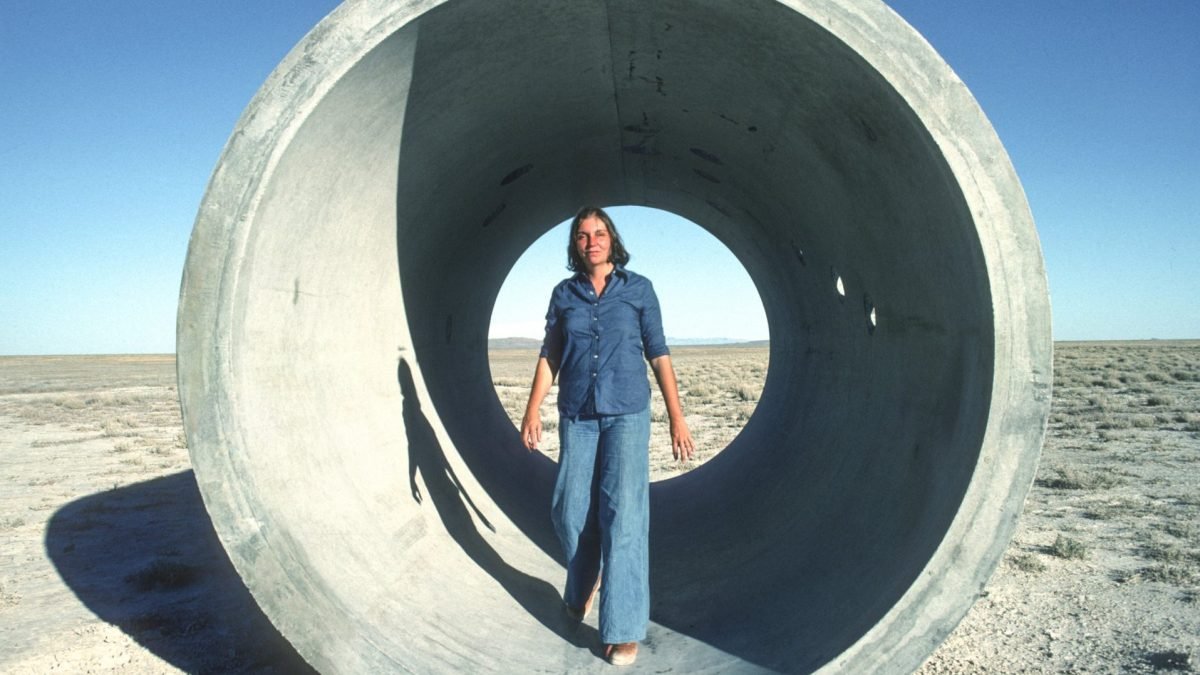
MoonSunStarEarthSkyWater is the biggest UK exhibition ever dedicated to Holt, who was born in Massachusetts in 1938 and died in 2014 aged 75. She was never as famous as her male peers. Still, over five decades, during which she evolved from small to large-scale work, she was an influential figure of land and conceptual art, best remembered for the monumental Sun Tunnels in the Utah desert, made between 1973-76, and again, not unreasonably, represented here in Holt’s fastidious photography.
Sun Tunnels’ concrete cylinders act like a modern-day Stonehenge, aligning with the sun at the solstices, and channelling sunlight through holes that map constellations onto the cylinders’ interior surfaces. The cylinders – units of manmade infrastructure – serve here as a conduit for the systems of stars and heavenly bodies that rule and regulate life on earth.

Though a long way from the Utah desert, Goodwood’s spectacular South Downs setting, landscaped by celebrity gardener Dan Pearson, demands restagings of Holt’s outdoor works.
Holt gave approval for certain works to be recreated according to her instructions and documentation, fabricated in situ by local craftspeople and, where possible, from locally sourced materials.

Just two have been recreated at Goodwood, including Ventilation System, a sprawling network of shiny steel pipes that extends through the gallery walls to the outdoors, where the pipes periodically terminate in fanned caps that flicker in the breeze like lazy disco balls. Inside the gallery, these elements move more quickly, accompanied by the sound of rushing air. Holt’s idea is to honour and recognise infrastructure that is taken entirely for granted and hidden from public view: just as Wistman’s Wood gave shape to the metaphysical bond between Robert Smithson and a corner of Dartmoor, Holt’s Ventilation System reveals a building’s inner workings.
Except, unfortunately, it doesn’t. Ventilation System is a sham, a dummy network of pipes plugged in to make the noise of working pipes, but actually doing nothing useful at all. Holt was an artist, not an engineer, but in our era of the climate crisis, this lack of functionality feels obscene and distracts from the fact that, though Holt was not exactly an environmentalist, she was certainly sensitive to the environment and its plight.

Her interest in the systems that order and regulate our existence ranges from the manmade – ventilation, electricity networks, heating and drainage – to the movements of stars and planets that shape life on earth, and are more effectively communicated by Hydra’s Head, which was originally conceived for the banks of the Niagara River in upstate New York. “Reactivated” at Goodwood, the work comprises six pools of water mapping part of the constellation hydra. Contained in prefabricated concrete pipes sunk into the hollow of a disused chalk quarry, each perfectly still pool acts as a dark mirror, in which are caught the reflections of sun and cloud, moon and stars.
Photographs were important to Holt, and more than just documentation, but even when accompanied by films and sketches, and a recreation of one of Holt’s indoor works, Mirrors of Light II (1974), they simply do not scratch the surface of Holt’s collaborative and visionary project. Recreating outdoor works, like Hydra’s Head, is more than an act of homage to an artist we should know more about; the logistics and the practicalities of the project demand discussion, co-operation and care – the bones of Holt’s work, and also its soul.
‘Nancy Holt: MoonSunStarEarthSkyWater’ is at Goodwood Art Foundation until 1 November