
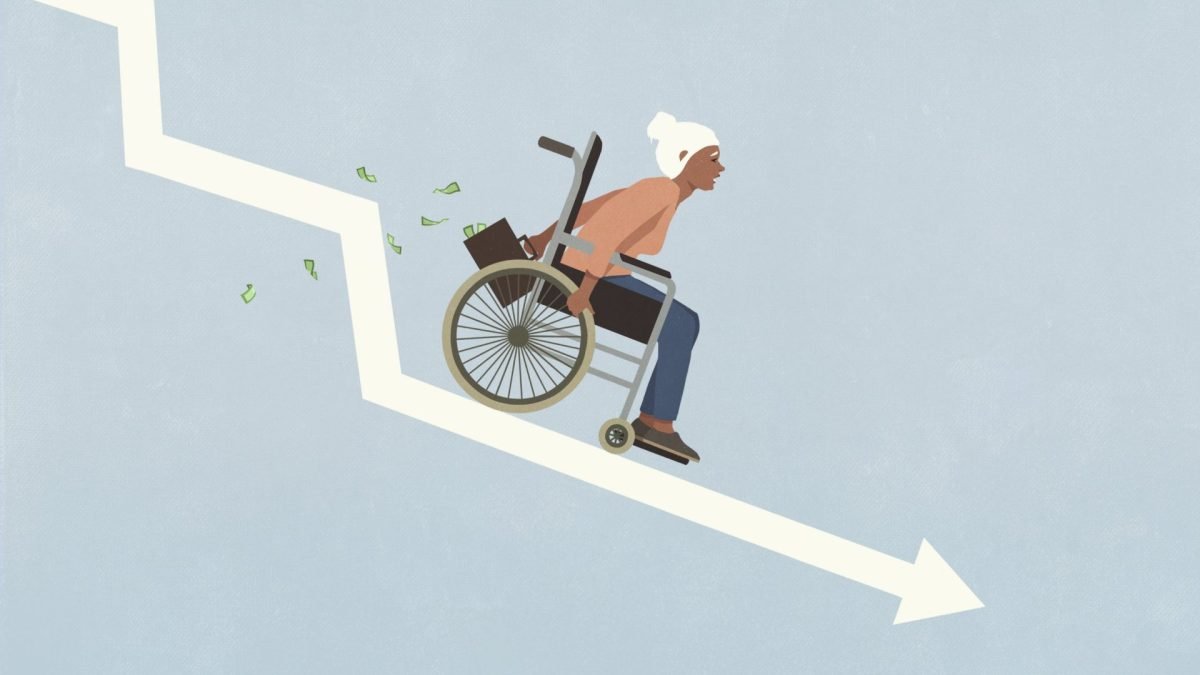

Rising living costs, longer life expectancies and uncertainty around future care needs are changing attitudes to retirement savings among those approaching pension age.
An increasingly popular idea, the so-called “U-shaped” retirement, is gaining traction.
This is the idea that you spend more at the start of your retirement – while you’re fit and active – ease off later, and keep a buffer for potential care costs at the end of life.
But experts warn that, while this pattern reflects real behaviour, relying on it too heavily could leave retirees exposed.
Financial planners say the U-shape is useful as a concept, but dangerous if treated as a rulebook. Real life, they stress, rarely follows a neat curve.
Here’s a rundown of how the plan works – and the pitfalls with it.
What is a “U-shaped” retirement?
The theory behind the U-shaped retirement is that spending tends to be highest in the early years of after you finish working, before dipping and rising again later, often due to health or care costs.
This broadly aligns with what planners see in practice. The early years, sometimes called the “go-go” phase, are when retirees travel, pursue hobbies and help family members financially.
Jason Hollands, managing director of Evelyn Partners, explained: “Amongst our clients, it’s very common to see higher spending in what I often describe as the ‘golden decade’ of retirement – typically the first 10 to 15 years.
“As clients move into their late seventies and eighties, discretionary spending usually falls away quite naturally.
“Later in life, spending can increase again, but in a very different way. It’s less about choice and more about necessity, particularly around healthcare or long-term care.”
Why it could leave you short of cash
There are many downsides to the U-shaped retirement, which experts warn about.
- You can’t predict how long you’ll live
One of the biggest risks is simply not knowing how long retirement will last, making it “impossible” to know how steep the “U” will be, Craig Rickman, personal finance editor at interactive investor, said.
This uncertainty makes it difficult to judge how much you can safely spend early on without jeopardising later years.
- Overspending early can backfire
Spending more in the early years is tempting and often encouraged. But it comes with trade-offs.
Rickman said: “People should absolutely make the most of their go-go years and spend money doing things they enjoy while they’re in good shape, otherwise they could hit their later retirement years drenched in regret.
“But equally, they should be mindful that retirement can last several decades, and being overly frivolous early on, especially if they’re heavily reliant on their pension savings and have little in the way of guaranteed sources to fall back on – could lead to financial hardship down the line.”
Tom Selby, director of public policy at AJ Bell, added that those intending to live “high on the hog” in the early years of retirement should have a clear eye on the impact this could have on their lifestyle later in retirement.
- Investment risks are greater at the start
Drawing heavily from investments early in retirement can amplify risks, particularly if markets fall and your pension is invested in them.
Hollands said: “Spending more in the early years can be entirely appropriate, but it needs to be balanced against market conditions and portfolio sustainability.”
- The “dip” in spending may never happen
A key assumption of the U-shape is that spending naturally falls in mid-retirement.
But that’s far from guaranteed, particularly if you become used to a certain level of spending, and find it hard to reduce your outgoings.
Alan Barral, financial planner at Quilter Cheviot, agreed: “The short answer is that the U-shaped idea broadly holds in practice, but it is far messier and less predictable than the theory suggests.”
Health, lifestyle and personal circumstances can all disrupt the pattern, he said, adding: “A client in their late seventies who is fit and socially active may spend more than they did at 65.”
- Care costs are unpredictable – and often underestimated
Selby said preparing for care needs is particularly difficult because how much care you might need and what it might cost are “inherently uncertain”.
He continued: “Many will prefer to keep some money set aside just in case, although those with property assets can also choose to use these if they need to pay for care – either through downsizing or equity release.”
The unpredictability makes it risky to rely on a neat spending curve.
- Inflation and policy changes can derail plans
Even well-planned retirements can be thrown off course by external factors.
Travel, care and energy costs have not moved in line with general inflation – which currently sits at 3.3 per cent – over the past decade, which distorts any simple curve based on historic averages.
There are also tax considerations, Rickman said. He added: “As any pension money you haven’t spent by the time you pass could be walloped with tax, it might make sense to spend more while you’re fit and healthy.”
Acting on this too aggressively could still create problems later though.
Perhaps the most important takeaway is that retirement planning should not be rigid. Instead, experts stress the need for adaptability.
Rickman noted: “From market performance and economic shifts to health changes, there are several variables that can affect your future income requirements.
“You might plan for a U-shaped retirement, but if things change, for example new rules or regulations are introduced, it’s important to have the flexibility to switch tack.”
Hollands added that good retirement planning is less about fitting clients into a predefined curve and more about building a flexible, resilient strategy that can adapt over time.