
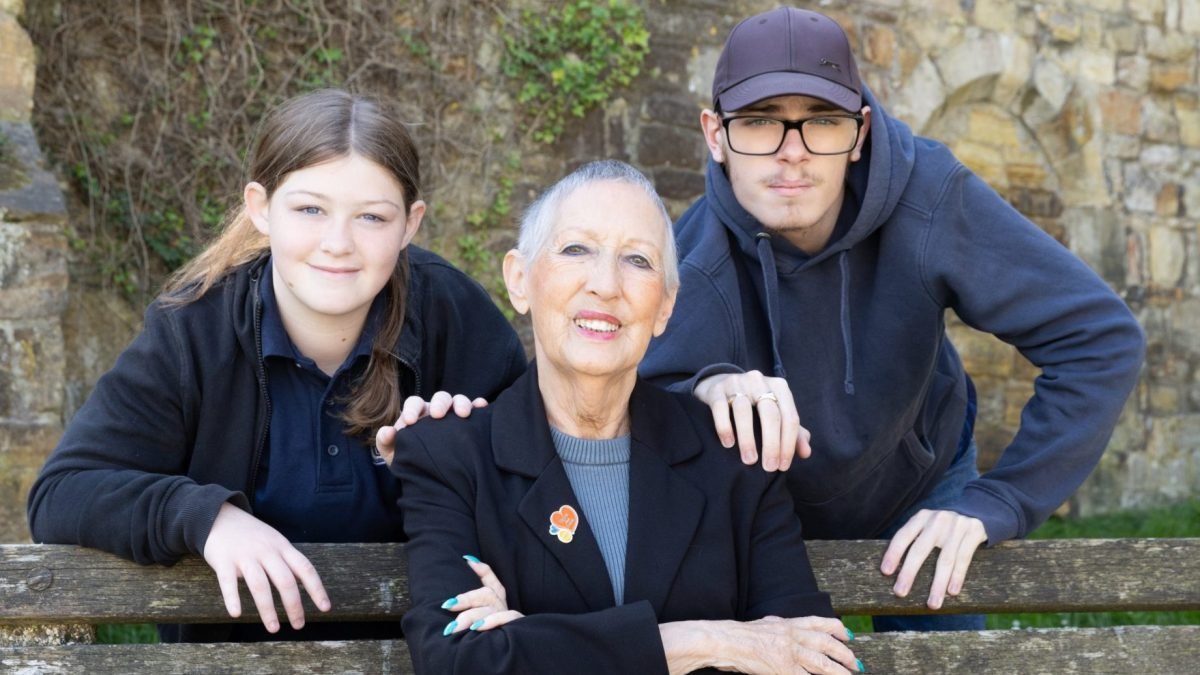
When Wendy Turner was in her late fifties, she and her husband were just beginning to enjoy their empty nest together in East Sussex. Their two adult children had left home, they had enough money to go on holidays – Wendy had a well-paid job as a book-keeper – and the house was tidy for the first time in years. “We were spending lots of time together again, me and my husband,” remembers Wendy, now 71, “and we were looking forward to retirement.” Then came the phone call.
Social services rang Wendy one morning to ask if they would come and get their 17-month-old baby grandson Callum – otherwise he would be put into the care system. Wendy was in shock. She had seen her grandson on a regular basis, and knew that her daughter and son-in-law were facing challenges, but hadn’t known that things had got so bad. “When you’re expecting a baby you’ve got time to plan for it,” says Wendy, “but in my case, we went from being lovely, fun grandparents to becoming full-time parents – and it happened overnight. There was no time to think.”
Every aspect of life was radically altered after that phone call. Social workers told Wendy she’d have to stop working in order to look after baby Callum – the time and attention she’d need to give him wasn’t compatible with a job. Wendy left her job immediately. Finances became strained, and Wendy’s husband worked extra hard to get early retirement, so he could help with his grandson at home.

They are two of a surprising number of people across the UK who, with no warning, are plunged into full-time, round-the-clock childcare for grandchildren. Census data estimates that at least 141,000 children in the UK are in kinship care – the term for when a family or friend takes on full parental responsibility when a child loses their birth parents as a result of death, a family court order, severe illness or imprisonment. Grandparents are the carers in 51 per cent of these cases. Of 2,000 kinship carers surveyed in 2025 by Kinship charity, half are over 65 and 34 per cent have found themselves raising two or more children. This kind of care arrangement is on the rise, according to Foundations, a UK charity for vulnerable families and children.
Baby Callum ended up permanently with Wendy and her husband, and then, two years later, just as Callum was about to start school, Wendy was told that her daughter was expecting another baby. “I knew that this child would come to me, too. So there I am, in my early sixties, with a newborn (a girl called Willow), doing night feeds and changing nappies – oh my goodness, it was quite something.”
Their role, and relationship to their grandchildren changed. “We lost that loveliness of, ‘Oh, come and stay with granny and we’ll have ice cream for breakfast’, and then send them home. Instead, we had to be the strict parents. And if I’m ever poorly, I just have to get on with it, there’s no sitting back on the sofa. I can’t ring granny for help like I did as a parent. But then there are so many things you are there for – the big milestones, teaching them to read, helping them find their talents, taking them on holiday. We met a lot of other grandparents taking their children on holiday. But of course, we’d be taking ours home with us.”

Wendy’s husband – Callum and Willow’s beloved grandfather – died almost four years ago. “We never did have our retirement together,” says Wendy, “and because I’m only human, sometimes when I’m making packed lunches in my seventies now, I do think, ‘I should be on a cruise ship somewhere,’ – but it’s not resentment, it’s just that some days it can feel a bit unfair. At the same time, I feel the pride in the children, and love for them, that any parent would. I’m so happy they’re safe and well. I can’t imagine life without them.”
‘It’s difficult but we wouldn’t change it for the world’
Meanwhile, in South Yorkshire, Michael* and his wife Sally* had, in 2017, just sold their four-bedroom house in order to downsize when they were asked to raise their grandchildren. Their older son was grown up and gone, and they had only their 11-year-old son still at home. They were temporarily renting a two-bedroom bungalow, before looking to buy their own little house to settle into for the future. “Then, literally at the stroke of a phone call,” says Michael, “our three grandchildren – two-and-a-half, three-and-a-half and six years old – came to live with us.”
Their son’s children had suffered severe neglect, hunger and physical harm at home. “We’d gained these three grandchildren, but we also felt we’d lost a son,” says Michael. “Your fears are suddenly confirmed that he’s failed as a parent, so you’ve got this grief for the life you’ve got that you’re not going to have and that you were looking forward to, a grief for your child who has failed as a parent, and grief on behalf of the children that they’re not going to have their life with their parents that they expected, and that you expected them to have.”
Before his three young grandchildren came to live with him, Michael – who is now still only in his ffties – was working all over the UK, training people to drive machinery. “My work bumbled on for two months,” he says, “I took as much annual leave as I could, but my employer was not very friendly about my situation – probably, in hindsight, because they had no idea about kinship care. In the end, I just had to quit. I had three traumatised children at home, a very upset young son in the house, a very upset wife, marriage being strained, and all sorts of things going on in the background. The pressure of work on top of all that was impossible.” Sally was working in retail, but she resigned the day the grandchildren arrived.
The Children Act (1989) demands that kinship care is used whenever possible for the long-term placement of children, but the financial and practical support offered is often very patchy, especially when compared to the support offered to foster carers, who are entitled to a minimum of £170 and £299 a week. Grandparents like Wendy and Michael also aren’t entitled to paid leave from work even when suddenly taking on a newborn baby.

Soon after their grandchildren came to Michael and Sally, they moved to rent a bigger home. The children had bedrooms, while Michael and Sally slept in the dining room. “Because of our work situation, we’d suddenly become unmortgageable,” says Michael, “so we spent a large amount of the deposit we had left from our house sale just keeping ourselves afloat for a year or more. At that point, we were well off the property ladder, out of the world of homeownership, and never to return.” Today, Michael works two jobs, while Sally is at home focused on the children.
Does Michael think of himself as a grandfather? “No, they’re all our children. We have four children in our home. There’s no two ways about it. Life has been hugely difficult, and it continues to be, but we wouldn’t change it for the world.”
One of the toughest things about being a grandparent like Michael is that because you’re a blood relative, and because you chose to step in rather than allow the grandchildren to be fostered, you’re often left to get on with it. Once you’ve taken charge, it’s a private family matter, and carers say that the over-stretched, under-funded social services tend to go quiet on them.
Nigel Priestley, a lawyer at Ridley & Hall and leading expert in kinship care and adoption breakdown, was awarded an MBE for services to family and children. Priestley – himself a former kinship carer – has for years taken on local authorities to get financial help for grandparents who end up in dire straits, unable to work, and struggling to access the professional, therapeutic support their grandchildren so often need.
“They’re often left outside the support system,” says Nigel. “When they try to get help they often find themselves banging on the door until their knuckles are bruised and bleeding. Yet this bunch of grandparent heroes are saving local authorities tens of thousands of pounds.” There is a glimmer of hope, though. As of February 2026, some grandparents who provide full-time care for their grandchildren to prevent them being taken into care are guaranteed financial support under a government pilot scheme. Kinship carers in seven council areas will get a financial allowance in line with that of foster carers, depending on where they live and the age of the child. This has been something campaigners have been fighting for for more than 20 years.
‘My life came crashing down’
Getting an allowance to help bring up her grandchild has been transformative for Lesley, 62, from Leeds, who had to quit her job in a vegetable factory 11 years ago to take in her two grandchildren, then aged two and four.
She was renting a two-bedroom flat, but one was a box room, so she had to move. Her vicar friend told the congregation about Leslie’s situation, and friends and strangers rallied, providing her with a bed for the children, food parcels, toys, and clothes. “I was so moved by their generosity,” she says, “because I was getting no wages, but I was also getting pressured by job seekers to get a job, even though I’d just given up a full-time job to look after the children.
“I hardly saw the social worker, who said I was doing a good job, but my life was turned upside down. I’d get phone calls from my friends asking if I was coming out, and I had to tell them no, I’ve got two kids now, and I can’t leave them with anyone else. I lost lots of friends. I had to start applying for benefits, but I’d worked all my life and never done that before. My life came crashing down.”
Lesley spent several years relying on food banks, charity shops, and friends – “scraping the barrel,” as she puts it – before going to court to fight for some help. “The judge said that I should have a financial package,” she says. “Now I can take the children places, on days out, to have a meal, just nice things to make good memories. I try to help them remember the good times and get rid of the bad times.”
In a 2023 study in the Journal of Women and Ageing, academics Jenny Birchall and Amanda Holt wrote; “Kinship carers are taking on a huge unpaid care burden and as a result are experiencing lif-changing economic penalties… we need a social, economic and cultural shift.”

The grandparents contacted for this article all said that through attending support groups and events for kinship carers, they’ve regained some form of social life, and realised that all kinds of grandparents, from all kinds of backgrounds and walks of life, can end up in their position.
Wendy’s grandchildren had an incredibly tough start in life, but they are doing well. Callum does football refereeing and Willow plays inline hockey for Team GB. Wendy- as well as Lesley, and Michael, and many other grandparents like them – continue to campaign for better support, and understanding.
“You think you’re the only person in the world doing this,” says Wendy, “until you find out you’re not. We’re the invisible army of forgotten carers. We battle these challenges every day while trying to look after the children and give them the best childhoods they can have. The childhoods that our grandchildren deserve.”
Kinship is the leading kinship care charity in England and Wales. It provides, information, support and advice to kinship carers through it’s peer support group network, advice line, training and campaigning.
The financial reality for kinship carers
- Kinship’s annual survey of nearly 2,000 kinship carers, grandparents, aunts, uncles and siblings, reveals that nearly one in five kinship carers report that either they, their kinship child, or another child in the family sleeps in unsuitable conditions due to lack of space and support
- Four in 10 (44 per cent) are using savings to cope with the high cost of living compared to 30 per cent of the population
- One in five (18 per cent) had a direct debit, standing order or bill they couldn’t afford to pay in the last month – three times the national average (6 per cent)
- Nearly one in three (28 per cent) are using credit more than usual, such as credit cards, loans or overdrafts, to provide for their children, nearly twice the national average (15 per cent)
- More than one in eight (13 per cent) remain concerned they won’t be able to continue caring for their kinship children in the next year, citing poor health, lack of support and financial worries
- Of the 2,000 kinship carers surveyed, 80 per cent of carers who stopped working when they became kinship carers have never returned to work