
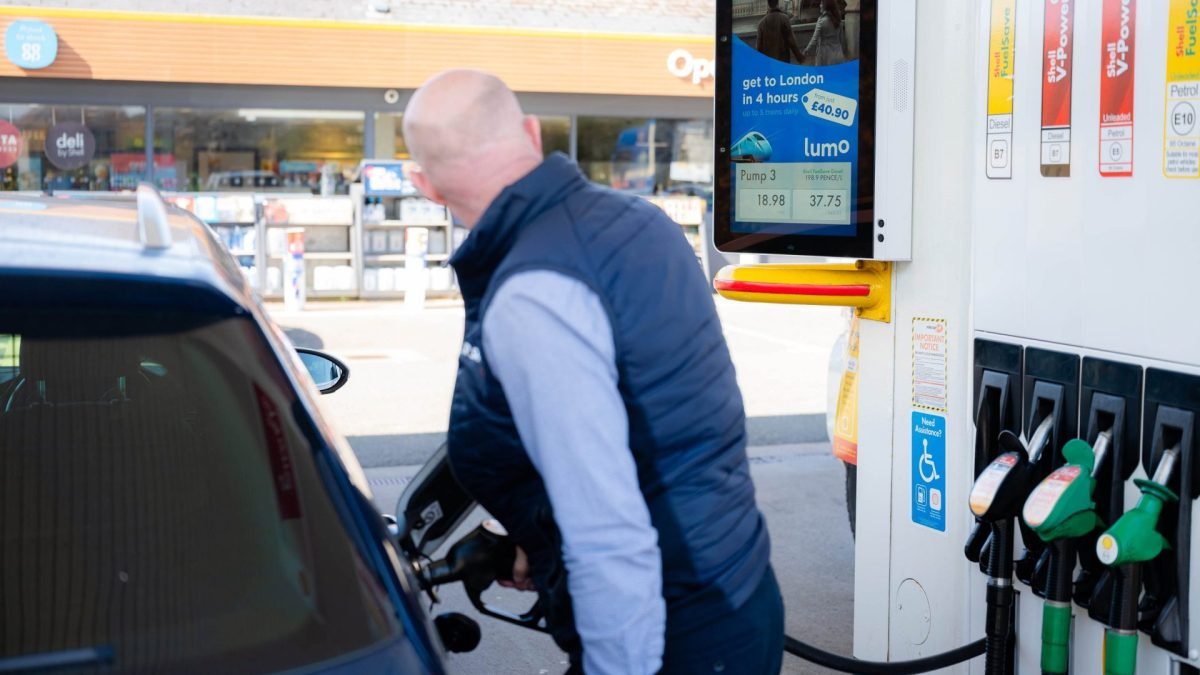
Oil stocks are dwindling to a critical level as the crisis in the Gulf continues, with experts now warning global markets are weeks away from a “tipping point” that will see prices soar beyond previous levels.
Prices have already reached a record high this week as Brent crude oil, the global benchmark for prices, rose by almost 7 per cent to more than $126 (£94) a barrel – the highest level since 2022.
But traders and analysts told the Financial Times that global stocks of crude, gasoline, diesel and jet fuel will hit a critical level by the end of May, which will push prices up even further.
Frederic Lasserre, head of research at oil traders Gunvor, told the newspaper they were no longer talking about months but rather weeks before “huge pain”.
He said: “It goes beyond gasoline at the pumps to industry shutting down – and you enter recession.
“The tipping point is clearly June. This is the point at which something has to give.”
It’s a view backed by Amrita Sen, founder of consultancy Energy Aspects, who said if the conflict continues until the end of June, all stocks would be exhausted and then “essentially you can pick a number when it comes to the oil price”.
Airline industry warning
The airline industry has already signalled a significant change pending by mid-June, while for some the issue has already come to a head.
Michael O’Leary, chief executive of Ryanair, told The Times airline rivals were “desperately” searching for ways to mitigate the situation with flight cancellations and consolidations, which could begin within weeks.
He said his company was in daily briefings with all big oil suppliers and there is “a modest improvement in the supply situation through to the end of May, early June” but he added that “nobody would give us any undertakings what happens in mid-June or thereafter”.

US air carrier Spirit Airlines says it’s going out of business after 34 years, ending operations immediately in the face of rising jet fuel prices.
O’Leary’s comments come after it was reported ministers are poised to give UK airlines permission to use a type of fuel currently used only by US carriers.
Airlines in Britain and Europe use Jet A-1 fuel, while planes in the US use Jet A fuel. Both fuels can be used in any jet aircraft and relaxing the rules could provide UK airlines with more options to avoid cancelling flights.
However, Sir Keir Starmer said earlier this week summer holidays may be hit by the ongoing crisis in the Middle East.
He told Sky News: “I can see that, if there’s more impact, people might change their habits… where they go on holiday this year, what they’re buying in the supermarket, that sort of thing.”
And Transport Secretary Heidi Alexander is expected to “level with” the public this weekend about the air travel situation, with the possibility of flight cancellations and contingency plans for long haul travel.
She is reported to be about to promote staycations in the UK as officials draw up plans warning people not to take long-haul flights to certain parts of the world if the situation deteriorates significantly.
Food and energy take a hit
The Bank of England warned on Thursday food and energy prices will be pushed up further by the Iran war this year.
Bank of England governor Andrew Bailey said: “Where we go from here will depend on the size and duration of the shock to energy prices itself driven by how the conflict in the Middle East evolves and how those higher energy prices affect consumer prices in the United Kingdom.
“The indirect effects on the inflation are likely to be largest for food prices since food production and distribution are energy intensive.”
In its worst-case scenario, the Bank of England warned inflation could reach 6.2 per cent next year, with interest rates peaking at 5.25 per cent.

Scott Walker, GB Potatoes chief executive, told Sky News the way the industry works means the impact of war-linked costs will have a longer term effect, with “inevitable” increases in 2027.
He said: “Down the line prices will have to rise because we have a lot of costs coming.”
The majority of UK potato producers, he said, work to annual growing contracts with their customers, giving certainty over incomes and prices for the year ahead.
However, he cautioned 2027 contracts would have to reflect a doubling of red diesel, used by agricultural vehicles, and some fertiliser prices which have been hit by the blockade.
Rising costs for energy, cooking oil and fish are already affecting prices, according to the National Federation of Fish Fryers.
Andrew Crook, president of the National Federation of Fish Fryers, told the BBC recently uncertainty in the Middle East is “causing concern” in the industry.
Domestic energy bills are set to rise this summer. The current bill for a household using a typical amount of gas and electricity is £1,641. But the Bank of England has suggested this will rise “close to £1,900” in July, as events in the Middle East play out.
A long haul to recovery
After launching air strikes on Iran on 28 February, Donald Trump claimed the initial projection for conflict was “four to five weeks but we have capability to go far longer than that”.
Sixty days into the war, Trump told Congress that “hostilities that began on February 28, 2026 have terminated” as a result of the current ceasefire ending the need to seek approval for a continued conflict.
But the ongoing US blockade in the Strait of Hormuz continues, with economic implications worldwide, as about 20 per cent of the world’s oil and liquefied natural gas (LNG) and a third of the world’s fertiliser trade usually passes through the shipping channel.

And there appear to be no signs of a resolution yet after Trump indicated on Friday that negotiations with Iran were not making much progress.
He said: “We just had a conversation with Iran. Let’s see what happens. But I would say that I am not happy.”
Later, he added: “We’re not going to leave early and then have the problem arise in three more years.”
Sir Keir Starmer has warned that even if a deal between the US and Iran can be reached, the economic implications of the conflict will continue to be felt for some time.
In an interview on BBC Radio 4’s Today programme, he said: “I think we obviously have to pull together countries to get the Strait of Hormuz open…and we need to get the Strait opened as quickly as possible.
“But even when that happens, I don’t want anybody to think that once the Strait of Hormuz is open, it all returns to normal. It won’t be like that.”